HackTheBox Sherlock - Tracer (DFIR)
HackTheBox Sherlock Tracer walkthrough: tracing PsExec lateral movement on a Windows workstation from the PsExec Operational log alone — counting executions, identifying the dropped PSEXESVC service binary, the .key file and named pipes, and proving which host the attacker moved laterally from by reading the recorded command line.
Scenario
Tracer is an Easy HackTheBox Sherlock (defensive / DFIR challenge). The Forela SOC believes an adversary is moving laterally with PsExec, and a junior analyst flagged PsExec activity on a single workstation. You are handed the triage from that one endpoint and must reconstruct the PsExec activity: how many times the tool ran, the service binary it dropped, the exact run it left behind, and — critically — which host the attacker moved laterally from.
“We believe a threat actor is lurking in our environment and using PsExec to move laterally. A junior SOC analyst reported PsExec usage on a workstation. Confirm how many times PsExec executed, identify the service binary and the artifacts it dropped, and determine the source host the attacker pivoted from.”
| Field | Value |
|---|---|
| Platform | HackTheBox — Sherlock |
| Category | DFIR / Windows lateral movement |
| Difficulty | Easy |
| Artifacts | Triage from Forela-Wkstn002 (Windows event logs, incl. PsExec Operational log) |
| Skills | PsExec internals, PSEXESVC service tracing, named-pipe analysis, command-line forensics |
Artifacts
Forela-Wkstn002triage — the collected Windows event logs from the affected workstation (the case directory holds the note plus a packaged evidence ZIP). The decisive channel is the PSEXESVC Operational log, where every PsExec service start, file-create, and named-pipe event is recorded; supportingSystem,Security, and Sysmon-style operational logs round out the timeline.
The whole case is endpoint-centric: the destination host (Forela-Wkstn002.forela.local) recorded the inbound PsExec service activity, and the recorded command line of one run reveals the source host the operator pivoted from. You never touch the attacker’s machine — its hostname falls out of the artifacts the service binary left behind.
Toolkit
- EvtxECmd (Eric Zimmerman) → CSV → Timeline Explorer for the PSEXESVC Operational,
SystemandSecuritylogs - A custom EVTX dashboard (my own DFIR triage UI) for fast keyword filtering (
psexesvc) and raw-record field inspection — shown in the screenshots below - Windows Event Viewer (native) with XPath filters as a fallback
- PECmd / MFTECmd (Eric Zimmerman) if you need to corroborate the
.keyfile’s creation against Prefetch or the MFT
1
2
3
4
5
# Carve every event log to CSV for Timeline Explorer
EvtxECmd.exe -d C:\Triage\Forela-Wkstn002\Windows\System32\winevt\Logs --csv . --csvf tracer.csv

# Or target just the PSEXESVC Operational channel
EvtxECmd.exe -f "PSEXESVC%4Operational.evtx" --csv . --csvf psexesvc.csv
Analysis — PsExec is loud on the destination host. When the client connects it writes PSEXESVC.exe to ADMIN$, registers and starts a service, and creates a set of named pipes (stdin/stdout/stderr) plus a per-host .key file for the encrypted channel. Each of those is a discrete, timestamped artifact — so “how many times did PsExec run” becomes a counting exercise over the service-start records, and “where did it come from” is answered by the host name baked into the pipe names, key file, and the recorded command line. (MITRE ATT&CK T1021.002 — SMB/Windows Admin Shares, T1569.002 — Service Execution.)
Background: PsExec artifacts on the destination host
PsExec achieves remote execution by abusing SMB admin shares and the Service Control Manager. Knowing the artifacts it leaves on the target is what makes this case tractable from a single endpoint.
| Signal | What it is | Why it matters here |
|---|---|---|
PSEXESVC.exe | service binary copied to ADMIN$ (C:\Windows\PSEXESVC.exe) | the dropper’s footprint; one per PsExec session |
Event ID 7045 (System) | “A service was installed” — service name PSEXESVC | classic SCM signal that PsExec ran |
| PSEXESVC Operational log | per-session service start / file-create / pipe events | lets you count executions and pull the source host |
PSEXEC-<HOST>-<id>.key | per-host key file for the encrypted comms channel | the host token in the name is the source workstation |
Named pipes \PSEXESVC-<HOST>-<pid>-{stdin,stdout,stderr} | I/O channels for the remote process | the host token again identifies the origin host |
| Recorded command line | e.g. PsExec64.exe \\Forela-Wkstn001 -u Administrator -i whoami | direct proof of the lateral-movement direction |
The trick of Tracer: the destination (Forela-Wkstn002) keeps records that name the source (Forela-Wkstn001) — in the key file, the pipe names, and the command line.
Investigation
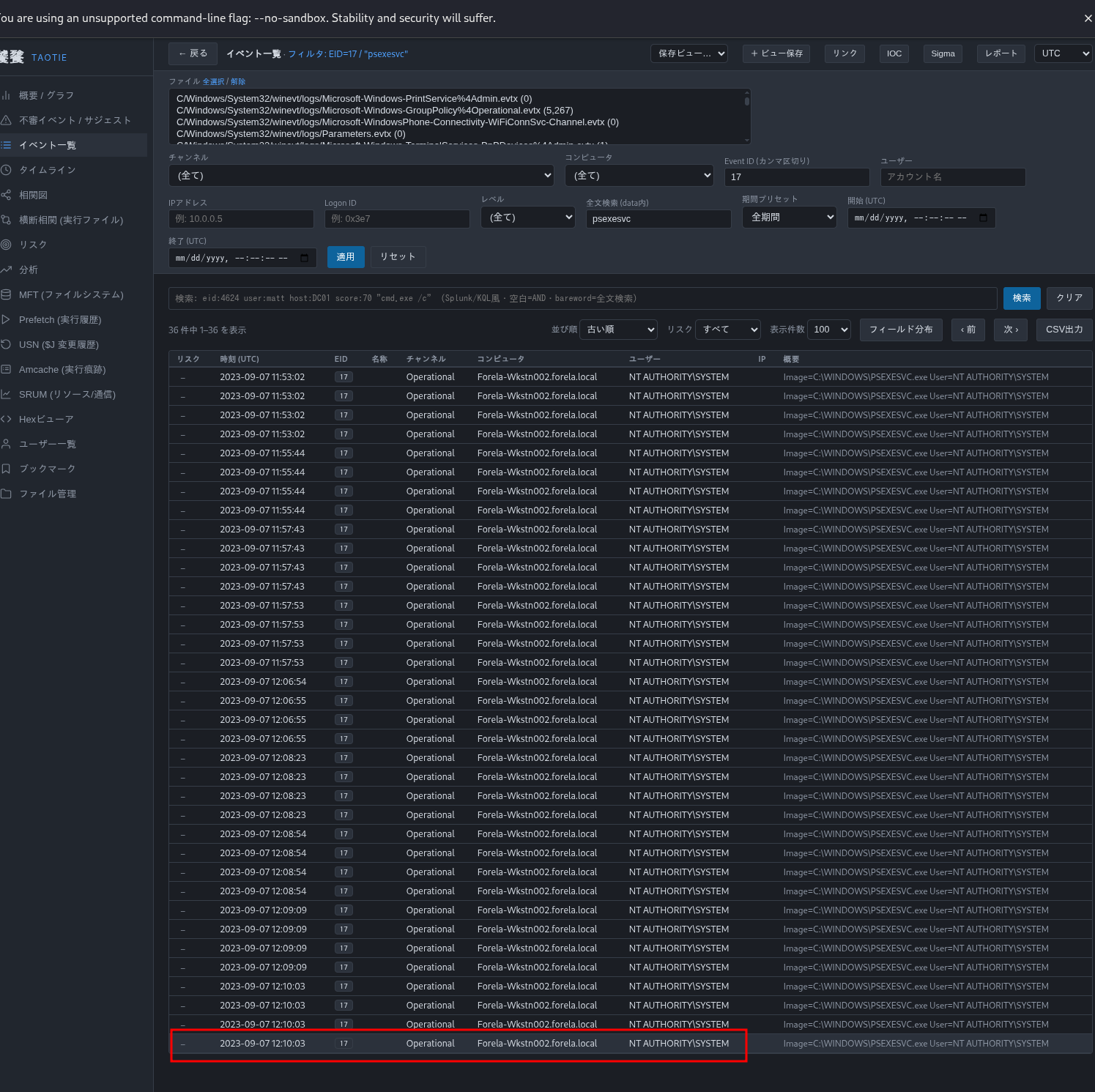
Q1. The SOC Team suspects that an adversary is lurking in their environment and are using PsExec to move laterally. A junior SOC Analyst specifically reported the usage of PsExec on a WorkStation. How many times was PsExec executed by the attacker on the system?
Filter the triage on the psexesvc keyword and count the distinct PsExec service-start events in the PSEXESVC Operational log. Each PsExec session opens a fresh service instance, so the number of those start records is the number of executions. Counting the highlighted psexesvc hits in the event message column gives nine distinct runs.
Answer
1
9
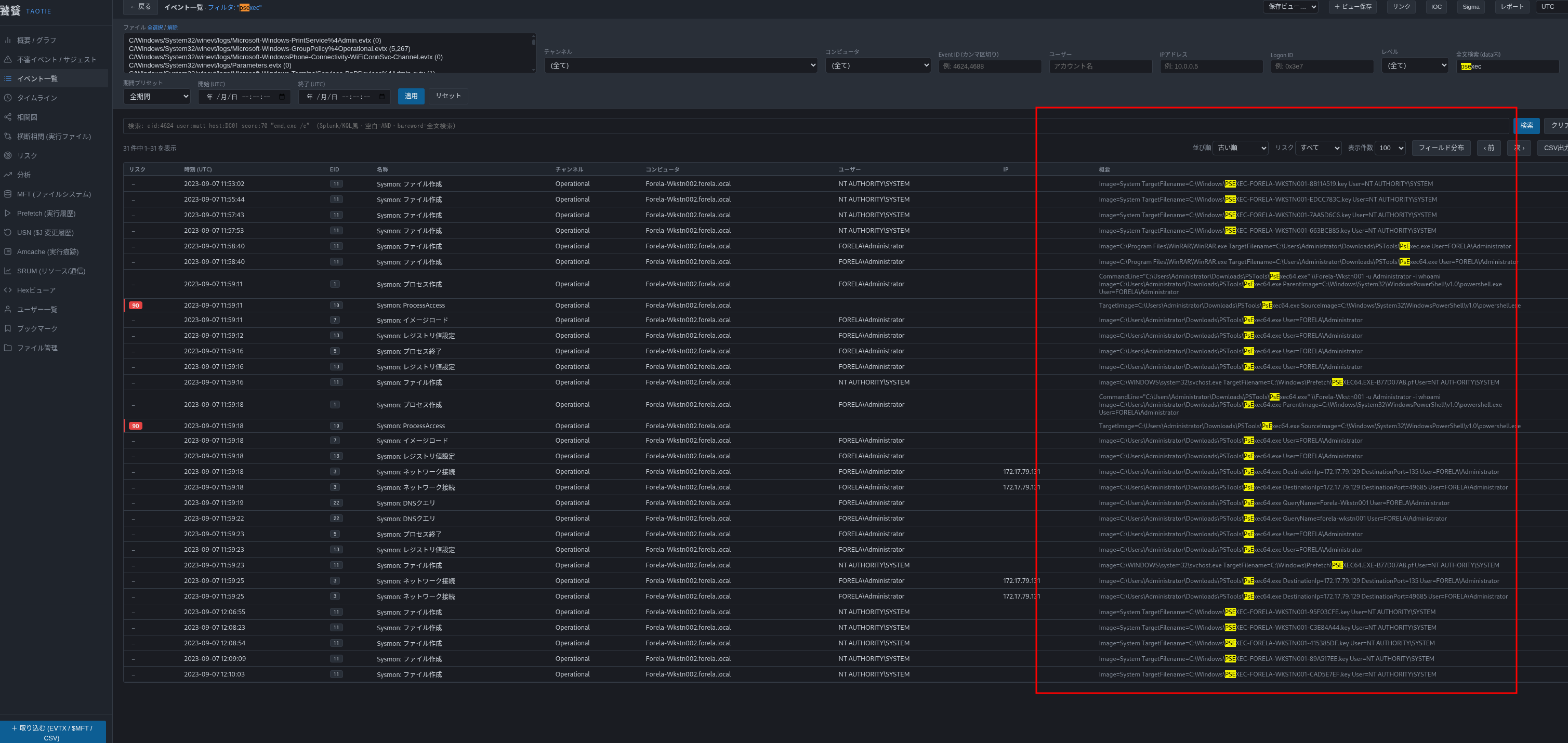
Analysis — Counting executions cleanly means counting service starts, not every line that mentions PsExec — a single run emits the service start plus several file-create and pipe events, so a naive grep over-counts. Anchoring on the per-session start record is what yields the true figure of nine. (MITRE ATT&CK T1569.002 — System Services: Service Execution.)
Q2. What is the name of the service binary dropped by PsExec tool allowing attacker to execute remote commands?
PsExec copies its service binary into ADMIN$ (i.e. C:\Windows\) and the SCM starts it as the PSEXESVC service. The triage alert panel for the PsExec lateral-movement instances names the dropped binary directly.
Answer
1
PSEXESVC.exe
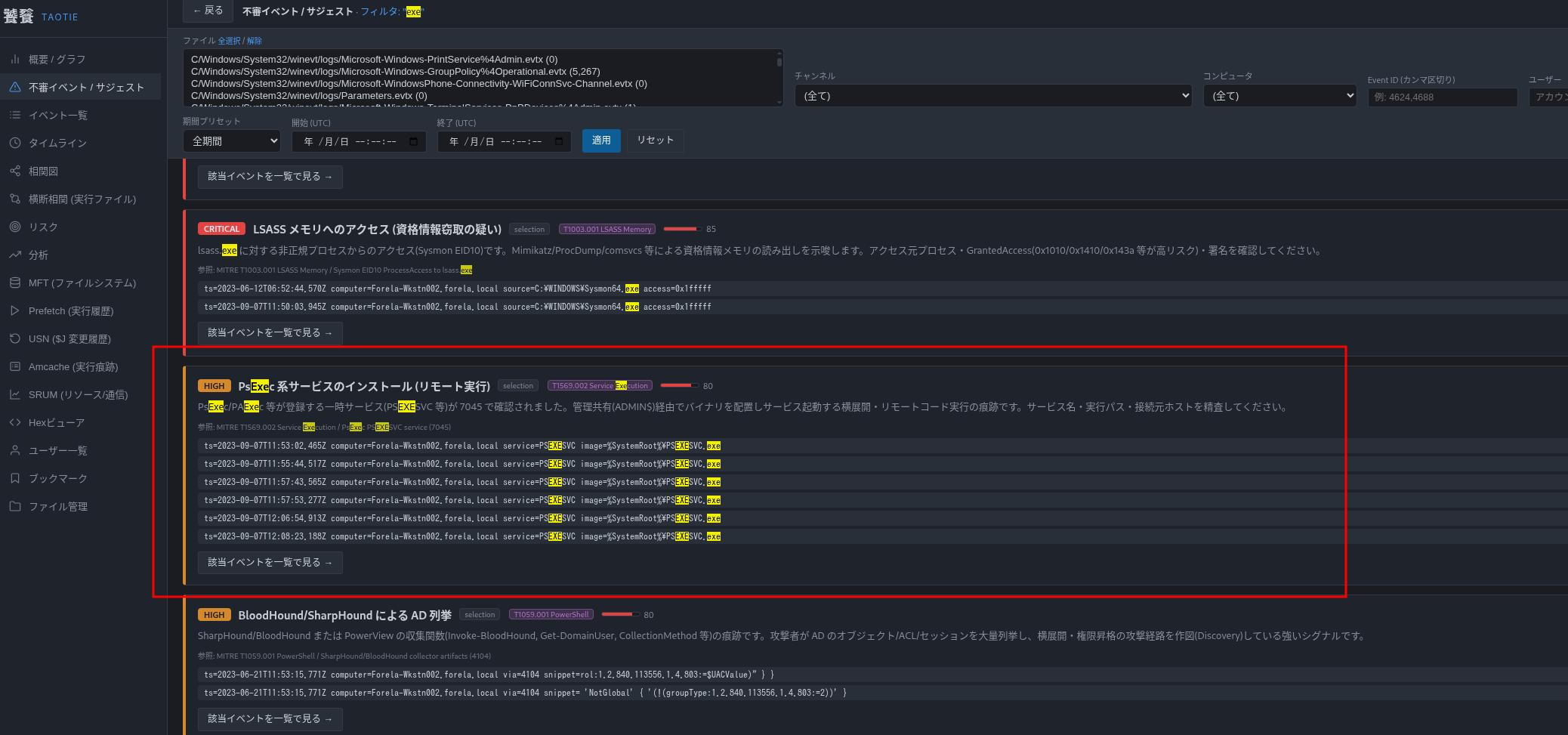
Analysis — PSEXESVC.exe is the on-disk fingerprint of PsExec: the client uploads it to the target’s ADMIN$, registers it as a service, and it acts as the local broker that spawns the requested command. Its presence in C:\Windows\ (or any Event ID 7045 naming the PSEXESVC service) is a high-fidelity indicator of remote execution. (MITRE ATT&CK T1570 — Lateral Tool Transfer.)
Q3. Now we have confirmed that PsExec ran multiple times, we are particularly interested in the 5th Last instance of the PsExec. What is the timestamp when the PsExec Service binary ran?
Sort the PSEXESVC Operational service-start records chronologically and walk back five from the most recent (the 5th-from-last run). The timestamp of that instance’s service-start event is the moment its PSEXESVC binary executed.
Answer
1
07/09/2023 12:06:54
Analysis — “5th last” is a deliberate anchor: rather than the first or last run, the challenge pins a specific session whose artifacts (key file, pipes, command line) you then correlate in the following questions. Establishing its exact service-start time first is what lets you tie the on-disk .key file and the named pipes to this run and no other.
Q4. Can you confirm the hostname of the workstation from which attacker moved laterally?
Open the raw event for the 5th-last PsExec run; the log itself lives on the destination host Forela-Wkstn002.forela.local. PsExec stamps the source host into the artifacts it leaves on the destination — the authenticating machine account is FORELA-WKSTN001$, and the dropped key file and \PSEXESVC-… named pipes are all named after FORELA-WKSTN001. Those fields identify the workstation the attacker moved laterally from.
Answer
1
Forela-Wkstn001
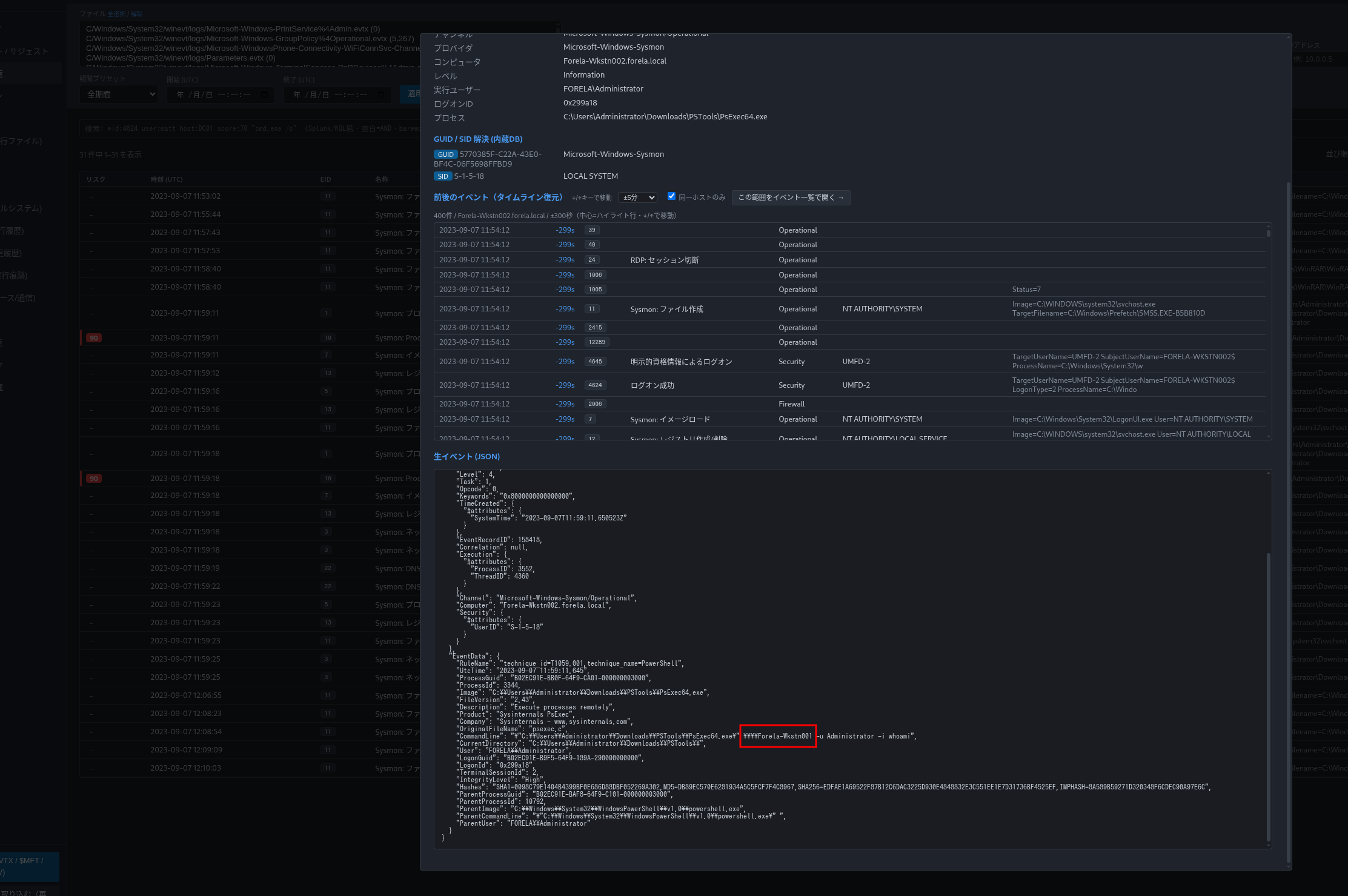
Analysis — This is the pivot of the whole case: the destination endpoint records the source host inside PsExec’s own artifacts — the FORELA-WKSTN001$ machine account plus the source-stamped key file and named-pipe names. Even with zero triage from the attacker’s machine, Forela-Wkstn001 is established as the origin of the lateral movement. (MITRE ATT&CK T1021.002 — Remote Services: SMB/Windows Admin Shares.)
Q5. What is full name of the Key File dropped by 5th last instance of the Psexec?
PsExec drops a per-host .key file used to set up the encrypted I/O channel. Filter the System/PSEXESVC file-create events for the 5th-last run and read the .key file name — the host token inside it again points at the source host.
Answer
1
PSEXEC-FORELA-WKSTN001-95F03CFE.key
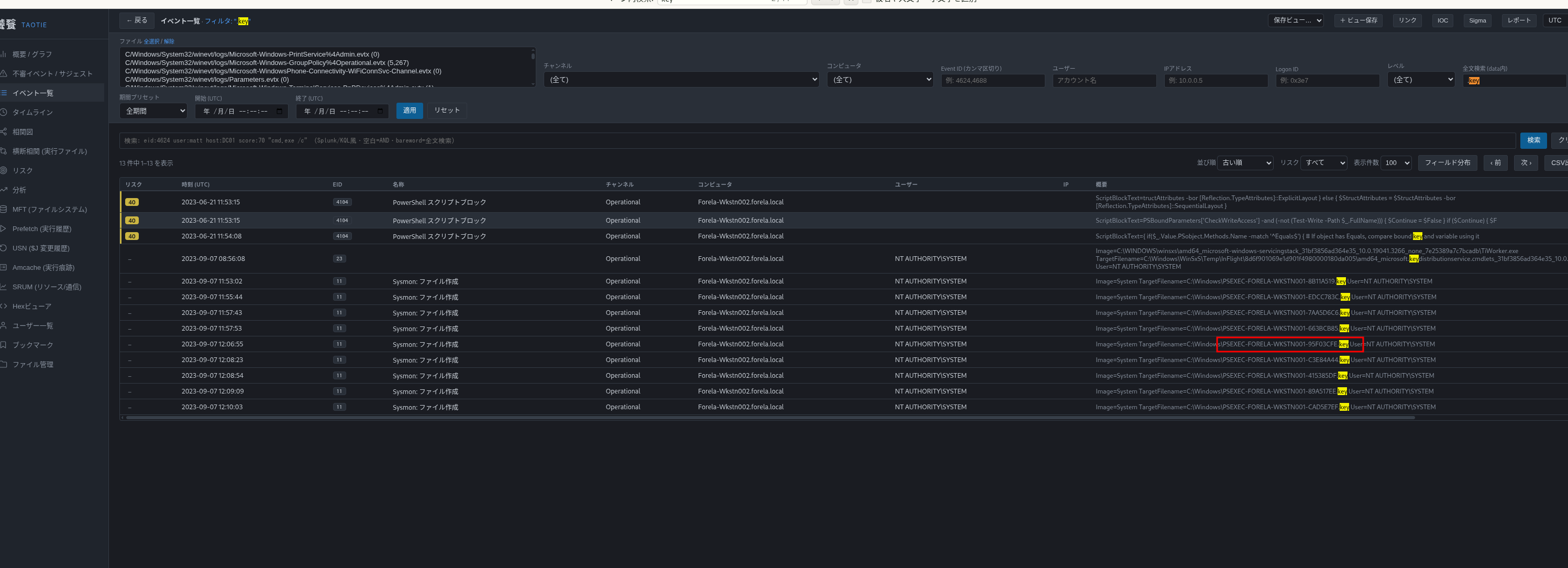
Analysis — The .key file naming convention PSEXEC-<SOURCEHOST>-<random>.key is itself an IOC: it corroborates the command-line finding that the operation originated from FORELA-WKSTN001, independent of any command-line logging. The random suffix (95F03CFE) ties the file to this specific session. (MITRE ATT&CK T1021.002 — SMB/Windows Admin Shares.)
Q6. Can you confirm the timestamp when this key file was created on disk?
Read the file-create timestamp of that .key file from the same record. It lands one second after the service binary ran — the service starts, then immediately writes its key material.
Answer
1
07/09/2023 12:06:55
Analysis — The one-second gap between the service-start (12:06:54) and the key-file creation (12:06:55) is exactly the expected PsExec sequence: launch service → establish encrypted channel. That tight ordering is what confirms the .key file belongs to the 5th-last run and not an adjacent session, and it gives the responder a precise on-disk artifact to hunt for across other hosts. (MITRE ATT&CK T1570 — Lateral Tool Transfer.)
Q7. What is the full name of the Named Pipe ending with the "stderr" keyword for the 5th last instance of the PsExec?
PsExec creates three named pipes per session — stdin, stdout, stderr — to relay the remote process I/O. Filter the operational pipe-create events for the 5th-last run and read the stderr pipe; its name embeds the source host and the service PID.
Answer
1
\PSEXESVC-FORELA-WKSTN001-3056-stderr
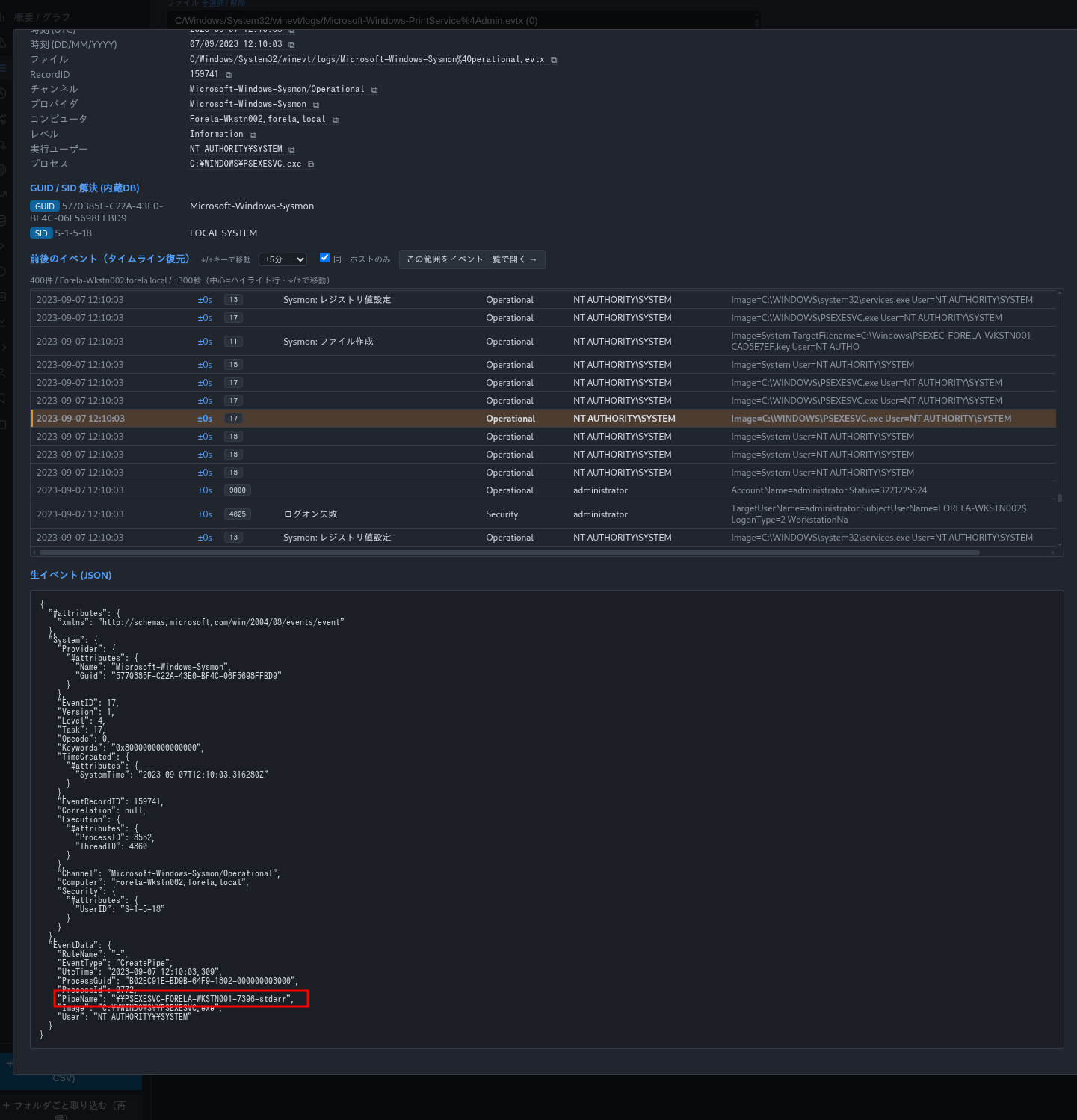
Analysis — The pipe name encodes three IOCs at once: the prefix PSEXESVC, the source host FORELA-WKSTN001, and the service PID 3056. It is the third independent artifact (after the command line and the .key file) that points back at the same origin host, giving the analyst high confidence in attribution. Hunting for \PSEXESVC-*-stderr pipes is also a practical live-detection rule. (MITRE ATT&CK T1021.002 — SMB/Windows Admin Shares, T1059 — Command and Scripting Interpreter.)
Attack Timeline
| Time | Stage | Evidence |
|---|---|---|
| (prior runs) | Lateral Movement | 9 total PsExec executions recorded on Forela-Wkstn002 — PSEXESVC Operational log |
| 07/09/2023 12:06:54 | Service Execution | 5th-last PsExec run — PSEXESVC.exe service started (cmd: PsExec64.exe \\Forela-Wkstn001 -u Administrator -i whoami) |
| 07/09/2023 12:06:55 | Lateral Tool Transfer | Key file PSEXEC-FORELA-WKSTN001-95F03CFE.key written to disk |
| 07/09/2023 ~12:06:55 | Command Execution | Named pipes created — \PSEXESVC-FORELA-WKSTN001-3056-stderr (+ stdin/stdout) |
flowchart TB

    subgraph EVID["Evidence"]
        direction LR
        V1["① PSEXESVC Operational — 9 service starts, PSEXESVC.exe dropped"]
        V2["② Command line — PsExec64.exe \\Forela-Wkstn001 -u Administrator -i whoami"]
        V3["③ Key file + named pipes — PSEXEC-FORELA-WKSTN001-95F03CFE.key / -3056-stderr"]
    end

    subgraph IOCS["IOCs"]
        direction LR
        O1["Service binary: PSEXESVC.exe (9 executions)"]
        O2["Source host: Forela-Wkstn001"]
        O3["Session artifacts: PSEXEC-FORELA-WKSTN001-95F03CFE.key,<br/>\PSEXESVC-FORELA-WKSTN001-3056-stderr"]
    end

    subgraph ATTACK["MITRE ATT&CK"]
        direction LR
        T1["T1021.002 SMB/Windows Admin Shares"]
        T2["T1569.002 Service Execution"]
        T3["T1570 Lateral Tool Transfer"]
    end

    V1 ==> O1
    V2 ==> O2
    V3 ==> O3
    V1 -.-> T2
    V2 -.-> T1
    V3 -.-> T3
Detection & Hardening (Blue Team)
What would have caught this earlier:
- Alert on Event ID 7045 with service name
PSEXESVC(and the binary pathC:\Windows\PSEXESVC.exe) — a near-perfect signature for stock PsExec. - Hunt for the named pipes
\PSEXESVC-*-{stdin,stdout,stderr}andPSEXEC-*-*.keyfiles — these survive even when attackers rename the executable, and the host token reveals the source. - Monitor
ADMIN$/IPC$writes of executables and SCM service creations from remote sessions — PsExec needs admin-share write + service install. - Restrict local Administrator reuse and enforce LAPS — the
-u Administratorin the captured command line is the classic shared-local-admin lateral path; unique per-host passwords break it. - Correlate destination-host PsExec artifacts back to a source host (key file / pipe names / command line), exactly as in this challenge, to scope which workstation to isolate first.
Key Takeaways
- PsExec is loudest on the destination: counting
PSEXESVCservice starts gives the true execution count (9 here), not a raw keyword grep. - The source host (
Forela-Wkstn001) is recoverable three independent ways from the victim alone — the recorded command line, thePSEXEC-FORELA-WKSTN001-*.keyfile, and the\PSEXESVC-FORELA-WKSTN001-3056-stderrpipe. - Anchoring on a specific run (“5th last”) and using the tight service-start → key-file → pipe sequence (
12:06:54→12:06:55) is how you attribute artifacts to one session with confidence.
References
- HackTheBox Sherlock: Tracer — https://app.hackthebox.com/sherlocks
- Microsoft Sysinternals — PsExec — https://learn.microsoft.com/sysinternals/downloads/psexec
- Microsoft — 7045: A service was installed in the system — https://learn.microsoft.com/windows/security/threat-protection/auditing/event-7045
- Eric Zimmerman’s Tools (EvtxECmd / Timeline Explorer / PECmd) — https://ericzimmerman.github.io/
- MITRE ATT&CK: T1021.002 (SMB/Windows Admin Shares), T1569.002 (Service Execution), T1570 (Lateral Tool Transfer)