HackTheBox Sherlock - Campfire-2 (DFIR)
HackTheBox Sherlock Campfire-2 walkthrough: detecting an AS-REP Roasting attack against Active Directory from the Domain Controller security log alone — spotting Event ID 4768 with Pre-Authentication Type 0 and RC4 (0x17), then correlating logons to attribute the compromised account that launched it.
Scenario
Campfire-2 is an Easy HackTheBox Sherlock (defensive / DFIR challenge). The Forela SOC suspects an AS-REP Roasting attack against the domain. This time you are given only the Domain Controller security log — no triage from the source workstation — and must confirm the attack, identify the roasted user, and then attribute the compromised account that performed it using the same DC log.
“We believe a threat actor performed an AS-REP Roasting attack against our Active Directory. You are provided with the Domain Controller security logs only. Confirm when the attack happened, which account was targeted, the workstation it came from, and — without any source-host artifacts — which account the attacker used to run the attack.”
| Field | Value |
|---|---|
| Platform | HackTheBox — Sherlock |
| Category | DFIR / Active Directory log analysis |
| Difficulty | Easy |
| Artifacts | Security.evtx (Domain Controller) only |
| Skills | Event ID 4768 triage, AS-REP Roasting detection, pre-auth analysis, logon correlation |
Artifacts
Security.evtx— the Domain Controller security event log, and the only evidence in this case. It holds the Kerberos4768AS-REQ/AS-REP records, plus the logon (4624) and network activity that let you attribute the source account.
The whole case is a single-log correlation exercise: the 4768 tells you what (a roasted user) and from where (an IP); the surrounding logon events on that same DC tell you who (the compromised account) — all without ever touching the source workstation.
Toolkit
- EvtxECmd (Eric Zimmerman) → CSV → Timeline Explorer for
Security.evtx - A custom EVTX dashboard (my own DFIR triage UI) for fast 4768 filtering and field inspection — shown in the screenshots below
- Windows Event Viewer (native) as a fallback with XPath filters
1
2
# Security log -> CSV for Timeline Explorer
EvtxECmd.exe -f Security.evtx --csv . --csvf security.csv
Analysis — AS-REP Roasting leaves its mark in exactly one event: the Domain Controller logs an Event ID 4768 (Kerberos TGT requested) for the targeted user — but with Pre-Authentication Type 0, meaning the account does not require Kerberos pre-auth. That single field is what separates a normal logon from a roastable account being harvested.
Background: AS-REP Roasting vs Kerberoasting
AS-REP Roasting abuses accounts that have “Do not require Kerberos pre-authentication” set (UF_DONT_REQUIRE_PREAUTH). Normally the DC demands an encrypted timestamp (pre-auth) before issuing a TGT; with pre-auth disabled, anyone can ask for that user’s AS-REP, which contains material encrypted with the user’s password key — crackable offline. Unlike Kerberoasting, no prior authentication is required, which is why it can be the very first foothold technique.
| Signal | What it is | Why it matters here |
|---|---|---|
Event ID 4768 | Kerberos authentication ticket (TGT / AS-REP) requested | the core DC-side signal for AS-REP Roasting |
PreAuthType 0 | no Kerberos pre-authentication | the fingerprint — a roastable account being harvested |
TicketEncryptionType 0x17 | RC4-HMAC | attacker forces RC4 because it cracks far faster than AES |
IpAddress | source of the AS-REQ | identifies the attacker workstation |
4624 / network logons | who was active on that workstation | attributes the compromised account used to launch the attack |
| Technique | DC event | Pre-auth | Ticket | Needs prior creds? |
|---|---|---|---|---|
| AS-REP Roasting | 4768 (TGT) | type 0 (disabled) | AS-REP | No |
| Kerberoasting | 4769 (TGS) | n/a | TGS-REP | Yes (any domain user) |
Investigation
Q1. When did the AS-REP Roasting attack occur, and when did the attacker request the Kerberos ticket for the vulnerable user? (UTC)
Filter Security.evtx on Event ID 4768, then keep only the request where Pre-Authentication Type = 0 and Ticket Encryption Type = 0x17 (RC4). Exactly one user account matches — the roast. The timestamp of that 4768 is the moment the attacker requested the AS-REP for the vulnerable user.
Answer
1
2024-05-29 06:36:40
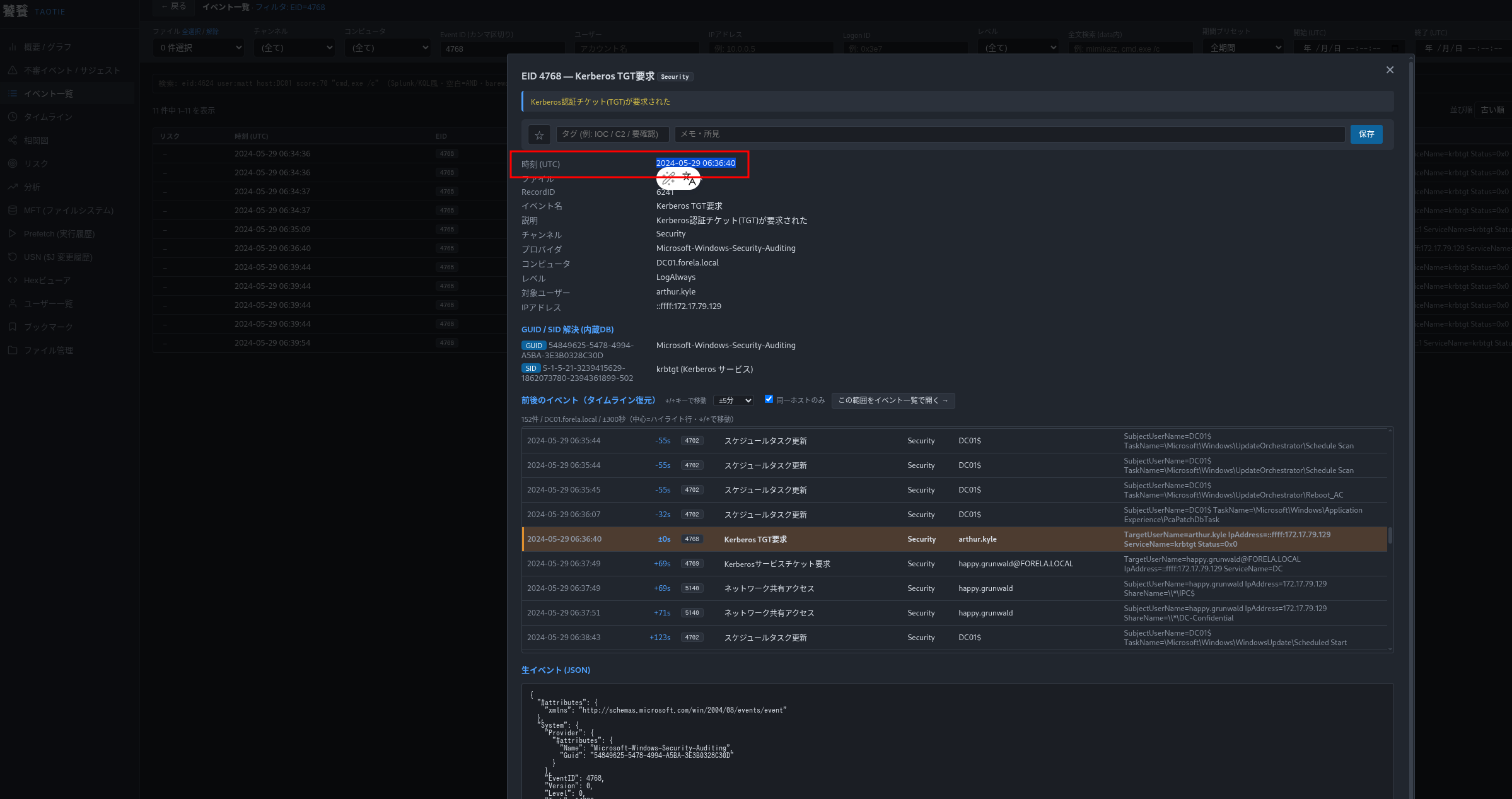
Analysis — For AS-REP Roasting, the AS-REQ and the attack are the same act: requesting the ticket is harvesting the crackable hash. So this one 4768 timestamp answers both halves of the question. The presence of PreAuthType 0 with RC4 (0x17) confirms it is a roast and not a normal logon. (MITRE ATT&CK T1558.004 — AS-REP Roasting.)
Q2. Please confirm the user account that was targeted by the attacker.
Read the TargetUserName of that matching 4768 event — the account whose pre-authentication was disabled and whose AS-REP was harvested.
Answer
1
arthur.kyle
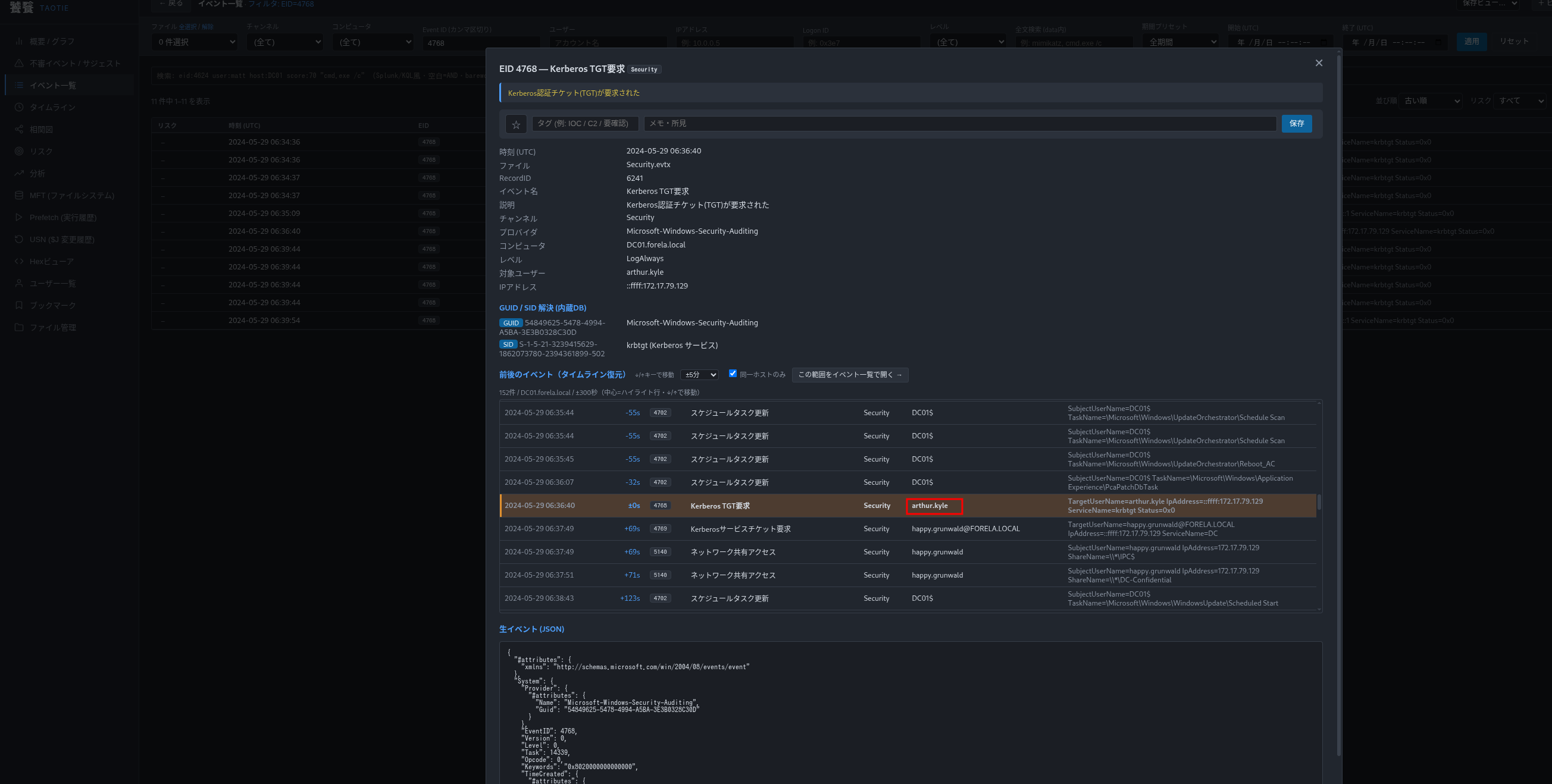
Analysis — The targeted account is the one with the dangerous DONT_REQ_PREAUTH flag. arthur.kyle’s password hash is now exposed to offline cracking, so it is the first account to reset and audit — and a reminder to hunt the whole domain for any other pre-auth-disabled users.
Q3. What was the SID of the account?
Read the TargetSid field from the raw event data of the same 4768 event.
Answer
1
S-1-5-21-3239415629-1862073780-2394361899-1601
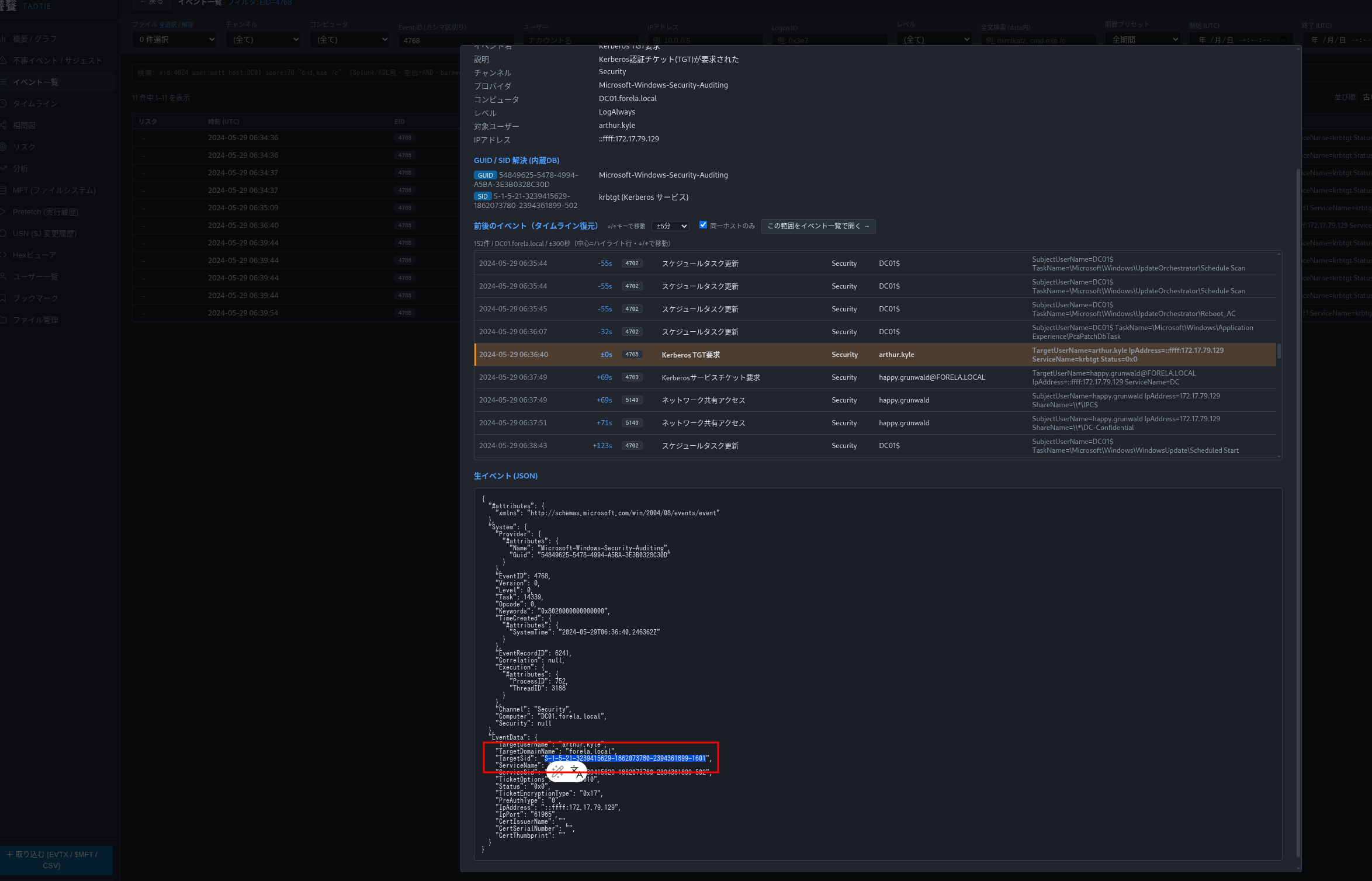
Analysis — The SID uniquely identifies the principal even if the account is later renamed. Recording it lets the threat-hunting team pivot reliably across other logs and systems where only SIDs (not display names) appear — for example service or scheduled-task contexts.
Q4. List the internal IP address of the compromised asset.
Read the IpAddress field of the same 4768 event (strip the IPv6-mapped prefix ::ffff: if present). This is the workstation the AS-REP request originated from.
Answer
1
172.17.79.129
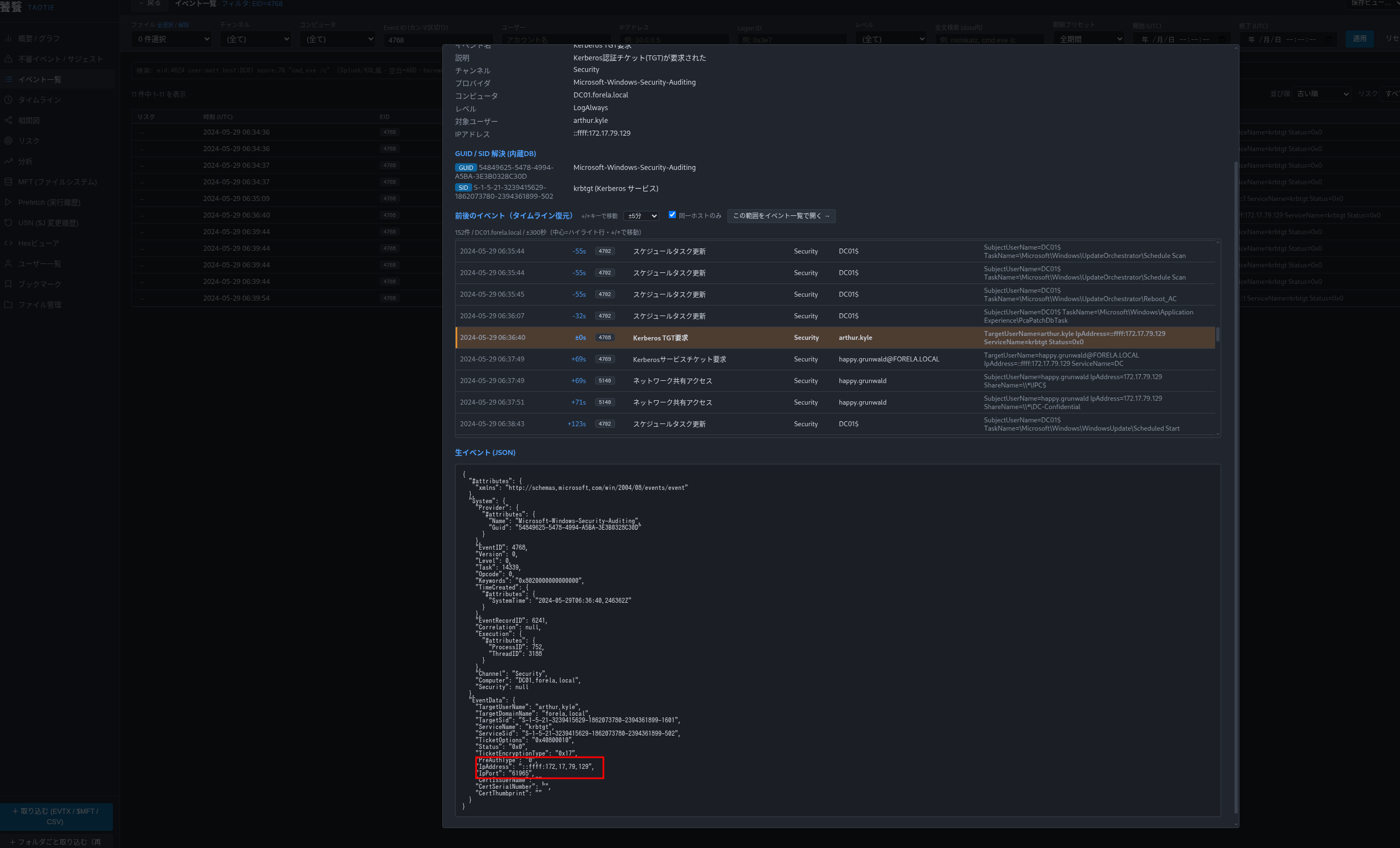
Analysis — Even though we have no triage from the source host, the DC still records where every ticket request came from. Pivoting to 172.17.79.129 is what turns “an account was roasted” into “it came from this asset,” giving the threat-hunting team a concrete machine to isolate and investigate.
Q5. Using the same DC security logs, which user account was used to perform the AS-REP Roasting attack?
This is the twist: AS-REP Roasting itself needs no authentication, so the 4768 doesn’t name the attacker. But the attack ran from a logged-on session on 172.17.79.129. Pivot to the logon and Kerberos activity from that same IP around 06:36:40 — the account actively authenticated on that workstation is the compromised one the attacker used.
Answer
1
happy.grunwald
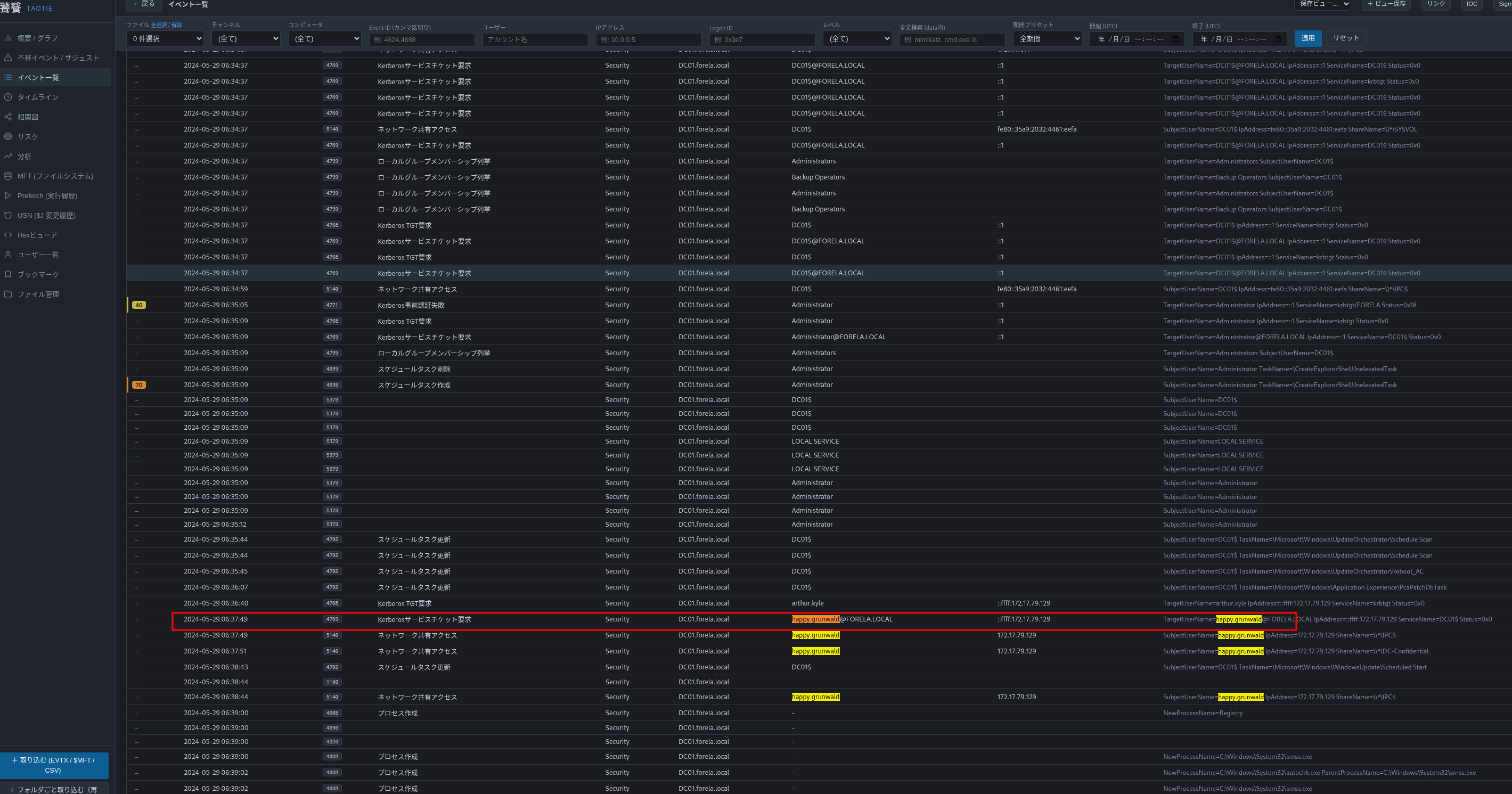
Analysis — This is the core DFIR lesson of Campfire-2: a roast doesn’t authenticate, so you attribute it by context. The same DC log that recorded the anonymous-looking 4768 also recorded happy.grunwald logging on and operating from the very same IP — so the compromised account that launched the roast is happy.grunwald, even with zero source-host artifacts. (MITRE ATT&CK T1078.002 — Valid Accounts: Domain Accounts.)
Attack Timeline
| Time (UTC) | Stage | Evidence |
|---|---|---|
| 2024-05-29 ~06:36 | Valid Accounts | happy.grunwald active on 172.17.79.129 — DC logon/Kerberos events |
| 2024-05-29 06:36:40 | Credential Access | AS-REP requested for arthur.kyle, PreAuth 0 + RC4 0x17, from 172.17.79.129 — EID 4768 |
| (offline) | Credential Access | AS-REP hash cracked offline → arthur.kyle password |
flowchart TB

    subgraph EVID["Evidence"]
        direction LR
        V1["① Security EID 4768 — arthur.kyle / PreAuth 0 / RC4 0x17"]
        V2["② Source IP field — 172.17.79.129"]
        V3["③ Logon correlation — happy.grunwald on same IP"]
    end

    subgraph IOCS["IOCs"]
        direction LR
        O1["Roasted user: arthur.kyle (SID …-1601, pre-auth disabled)"]
        O2["Compromised workstation: 172.17.79.129"]
        O3["Compromised account (launcher): happy.grunwald"]
    end

    subgraph ATTACK["MITRE ATT&CK"]
        direction LR
        T1["T1558.004 AS-REP Roasting"]
        T2["T1078.002 Valid Accounts"]
        T3["T1110.002 Password Cracking"]
    end

    V1 ==> O1
    V1 ==> O2
    V2 ==> O2
    V3 ==> O3
    V1 -.-> T1
    V3 -.-> T2
    V1 -.-> T3
Detection & Hardening (Blue Team)
What would have caught this earlier:
- Alert on Event ID 4768 with
Pre-Authentication Type 0for user accounts — pre-auth should almost never be disabled, so any such TGT request is high-signal AS-REP Roasting. - Audit and remove
DONT_REQ_PREAUTHacross the domain (Get-ADUser -Filter {DoesNotRequirePreAuth -eq $true}) — there is rarely a legitimate reason for it. - Disable RC4 for Kerberos and enforce AES, so a harvested AS-REP is far harder (or impossible) to crack.
- Enforce strong, long passwords on any account that must keep pre-auth disabled — offline cracking is the whole point of the attack.
- Correlate
4768/4624source IPs to attribute roasts to a compromised account even without endpoint artifacts, exactly as in this challenge.
Key Takeaways
- The AS-REP Roasting fingerprint on a DC is EID 4768 + Pre-Auth Type 0 + RC4 (0x17) for a user account — no
4769, no pre-auth, no prior creds needed. - With only the DC log you can still recover the full story: the roasted user (
arthur.kyle), its SID, the source workstation (172.17.79.129), and — by correlating logons — the compromised account that launched it (happy.grunwald). - Defenders win by removing pre-auth exceptions, killing RC4, and alerting on
PreAuthType 0.
References
- HackTheBox Sherlock: Campfire-2 — https://app.hackthebox.com/sherlocks
- Microsoft — 4768(S, F): A Kerberos authentication ticket (TGT) was requested — https://learn.microsoft.com/windows/security/threat-protection/auditing/event-4768
- Eric Zimmerman’s Tools (EvtxECmd / Timeline Explorer) — https://ericzimmerman.github.io/
- MITRE ATT&CK: T1558.004 (AS-REP Roasting), T1078.002 (Valid Accounts: Domain Accounts), T1110.002 (Password Cracking)